Today's
EarthStation1.com 15% (Or More!) Off Commemorative Memorial Title:
WJSV Radio Entire Broadcast Day 9/21/1939 MP3 CD, Download, USB
Drive
Today, September 2, 2026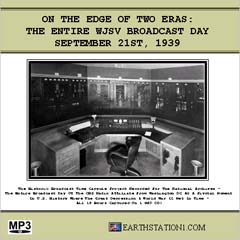
September 2: World Coconut Day: -- You
can't make a pina colada or a decent Thai curry without it! Its
water makes a great recovery drink, and its fibrous husk, when
burned, repels mosquitos - these are just three of many excellent
reasons to celebrate World Coconut Day. One of nature's most
versatile products, the coconut plant (and its various parts) can
be used for food and drink, cosmetic preparations, and decorating.
Some coconut proponents (cocoproponents?) even claim that the
fruit's oil can reverse dental decay - if you swish it around in
your mouth for 20 minutes a day! Most of us aren't comfortable
with a mouthful of oil, no matter whence that oil comes or what
it's purported to do. But we can still get caught up in the
coconut craze. Whether you're stuck on a deserted island or
comfortable in your own home, here are some (relatively normal)
ideas for using this tropical wonderfruit. We are just coconuts
for coconuts on World Coconut Day. The aim of celebrating this
holiday is to bring coconuts into the spotlight and recognize
their importance and benefits - not just health-wise but
economically too. Coconuts are especially celebrated in Asian- and
Pacific regions by the APCC, Asian and Pacific Coconut Community,
which facilitates most of the coconut production centers. The
coconut's adorable name has an interesting origin. As portrayed in
many cartoons and children's illustrations, there are three
indentations on the surface of a coconut, which resemble a human
face. Ancient Iberian folklore tells us that when the Portuguese
and Spanish explorers saw these indentations, it reminded them of
the bogeyman or a similar entity. The mythical character from
stories of their native lands was called 'Coco,' and so, the word
'coconut' was born. The coconut made its way from India to the
coast of East Africa, thanks to Arab sailors, and from Southeast
Asia to the west of Madagascar in the Indian Ocean and to the east
of the Pacific, thanks to Austronesian sailors. Coconuts have been
a powerhouse since, providing us with a vast range of products and
benefits. The tender white flesh inside the coconut is used in an
array of cooking recipes and the oil, milk, and water is used for
both cooking and non-cooking purposes. Coconut butter, coconut
cream, and coconut oil are staple byproducts used in beauty
products, and the husks and leaves of coconuts are used for making
doormats, roofs, and huts. The first observance of World Coconut
Day took place in 2009, commemorating the creation of the APCC.
Every year, the International Coconut Community sets a theme for
World Coconut Day. In 2020, the theme was 'Invest In Coconut To
Save The World.' On Sale Until Midnight Tonight PT!
https://store.earthstation1.com/wjsv-radio-mp3-cd-entire-broadcast-day-sep-3211939.html
Today's
EarthStation1.com 15% (Or More!) Off Commemorative Memorial Title:
Fight Against Fanaticism! Anti-Repression Films DVD, MP4, USB
Drive
Today, September 2, 2026
September 2: National Live Fearless Day:
-- A day that urges people to live fearlessly! This day encourages
individuals to appreciate the people in their lives that have been
there to support them. It also calls for people living without the
best or fullest expression of themselves to pursue activities that
inspire courage, such as taking a class, learning a new skill, or
making a bold career move. We can practice fearlessness every day
by being authentic and staying true to our inner selves. But,
today is a special day when we focus on ourselves and recommit
ourselves to personal growth! Have you ever been faced with a
situation where you found yourself paralyzed with fear? You were
frozen in place, unable to act until someone or something shifted
the situation, removing the pressure and finally allowing you to
go forward with courage. Few of us can claim we have never been
afraid of something in our life. Let's agree on one thing: life is
unpredictable, and terrible things happen daily. There's no way
around it, and it's impossible to predict. Fear is a distressing
emotion aroused by impending danger, the perception of an enemy,
or some personal threat. It is the feeling or state of mind that
precedes the fight-or-flight response. Fear can also be a response
to pain or discomfort and the unpleasantness of an emotional state
such as anxiety. It can have many physical effects: increasing
heart rate and muscle tension, quickening breathing, constricting
blood vessels, dilating pupils, and accelerating metabolism. Some
people experience fear as a painful sensation that results in
agitation, while others may feel fear as more of a general
discomfort than a particular emotional state. Landry Champlin
created National Live Fearless Day in 2020. The goal is to inspire
everyone to face their fears and pursue their dreams. Landry
started the movement after seeing countless people around her
afraid to pursue their dreams because of fear. She was tired of
seeing people living short lives, so she decided to do something
about it. On Sale Until Midnight Tonight PT!
https://store.earthstation1.com/fight-against-fanaticism-us-antirepression-films-dvd.html
Today's
EarthStation1.com 15% (Or More!) Off Commemorative Memorial Title:
The World: A Television History Documentary Series DVD, Download,
USB
Today, September 2, 2026
September 2: Calendar Adjustment Day: --
Celebrates the day that the Gregorian Calendar was adopted by
Great Britain on September 2, 1752, nearly two centuries later
than most of Western Europe. In order for Britain to shift from
the Julian calendar to the Gregorian calendar, it required
omitting 11 calendar days. Accordingly, the residents of Britain
and the American colonies went to sleep at night on September 2,
1752, and woke up the next day to September 14, 1752. This change
also led to New Year's Day being celebrated on January 1. Those 11
days are lost forever in time. The calendar adjustment wasn't
taken too well by the public, who felt cheated and demanded to
have their 11 days back. It was necessary to skip these 11 days in
September so that Britain could align with the Julian calendar,
like most of Europe. Many historians claim that the change in
calendar led to rioting and civil unrest, demanding "Give us
our 11 days." Many people also believed that their lives were
shortened by 11 days. The moving of some holy days and holidays
like Easter was also seen as suspicious and the new dates were
considered "incorrect." To avoid confusion, colonial
records use the terminologies 'Old Style' and 'New Style' to
differentiate between dates in history. These dates are denoted by
using a slash mark (/). The changeover involved a number of
different steps. First, the last day of the month, December 31,
1750, was succeeded by January 1, 1750. Before, December was the
10th month in the Old Style calendar, and January was the 11th.
Next, changes were made to March 24. Previously, March 25 was
considered the start of the New Year in the Old Style calendar.
The next change was January 1, 1752 following December 31, 1751.
As stated before, the new year started with March 25 in the Old
Style year. Lastly, September 2, 1752 was followed by September
14, 1752. This is the part where 11 days from the year were
omitted. On Sale Until Midnight Tonight PT!
https://store.earthstation1.com/the-world-a-television-history-4-dual-layer-dvds-all-26-sh426.html
Today's
EarthStation1.com 15% (Or More!) Off Commemorative Memorial Title:
The Old Time Radio World War II MP3 MegaSet DVD, Audio Download,
USB
Today, September 2, 2026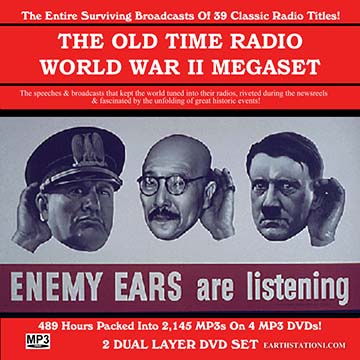
September 2: Victory Over Japan Day (V-J
Day, Victory In The Pacific Day, V-P Day): -- September 2, 1945
(Tokyo Time): September 2, 1945: World War II: The Pacific War
(The Asia-Pacific War, The Asiatic-Pacific Theater, The Pacific
Theater Of World War II): The Aftermath Of World War II: The
Aftermath Of The Pacific War: The End Of World War II In Asia: The
Surrender Of Japan: Victory Over Japan Day (V-J Day, Victory In
The Pacific Day, V-P Day): V-J Day No. 2 (September 2, 9:08 AM
Tokyo Time; September 1, 8:03 PM Eastern Daylight Time, celebrated
September 2) (the other is August 15 Japan Time, August 14 US
Time): -- Mere minutes after the conclusion of the live shortwave
broadcast of the Japanese surrender to the Allies that was
instantly retransmitted by AM radio across the US, Pres. Truman
broadcasts by radio his declaration of V-J Day (Victory over Japan
Day) commemorating the surrender. #JapaneseInstrumentOfSurrender
#VJDay #VictoryOverJapanDay #VictoryInThePacificDay #VPDay
#WorldWarII #WWII #WW2 #WorldWarTwo #WorldWar2 #SecondWorldWar
#PacificWar #AsiaPacificWar #AsiaticPacificTheater
#SurrenderOfImperialJapan #HarryTruman #PresidentsOfTheUS #POTUS
#MP3 #AudioDownload #DVD On Sale Until Midnight Tonight PT!
https://store.earthstation1.com/the-old-time-radio-world-war-ii-megaset-2-dual-layer-mp3-dv23.html
Today's
EarthStation1.com 15% (Or More!) Off Commemorative Memorial Title:
Douglas MacArthur Radio Broadcasts & Speeches MP3 CD,
Download, USB
Today, September 2, 2026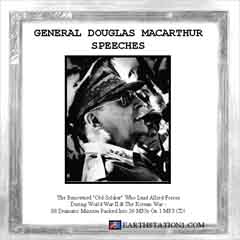
September 2: Victory Over Japan Day (V-J
Day, Victory In The Pacific Day, V-P Day): -- September 2, 1945
(Tokyo Time): World War II: The Pacific War (The Asia-Pacific War,
The Asiatic-Pacific Theater, The Pacific Theater Of World War II):
The Aftermath Of World War II: The Aftermath Of The Pacific War:
The End Of World War II In Asia: The Surrender Of Japan: Victory
Over Japan Day (V-J Day, Victory In The Pacific Day, V-P Day): V-J
Day No. 2 (September 2, 9:08 AM Tokyo Time; September 1, 8:03 PM
Eastern Daylight Time, celebrated September 2) (the other is
August 15 Japan Time, August 14 US Time): -- The end of World War
II, the bloodiest war in history, occurs as The Japanese
Instrument Of Surrender is signed by Japanese Foreign Minister
Mamoru Shigemitsu aboard the battleship USS Missouri in Tokyo Bay
at 9:08 a.m., where U.S. General of the Army Douglas MacArthur,
the Commander in the Southwest Pacific and Supreme Commander for
the Allied Powers, accepts the surrender on behalf of the Allied
Powers and signs the surrender document in his capacity as Supreme
Commander. The proceedings were broadcast live by shortwave radio
worldside, and retransmitted by AM radio by each the Allies'
respective radio networks. On August 14, President Truman had made
the official announcement that Japan had surrendered to the
Allies, which served to bring about the effective end of the war
until the official, ceremonial and legal end of the war occurred
with the singing of the surrender document on September 2.
#JapaneseInstrumentOfSurrender #VJDay #VictoryOverJapanDay
#VictoryInThePacificDay #VPDay #WorldWarII #WWII #WW2 #WorldWarTwo
#WorldWar2 #SecondWorldWar #PacificWar #AsiaPacificWar
#AsiaticPacificTheater #SurrenderOfImperialJapan #DouglasMacArthur
#MP3 #AudioDownload #DVD On Sale Until Midnight Tonight PT!
https://store.earthstation1.com/general-douglas-macarthur-mp3-cd-speeches-and-broadcast3.html
Today's
EarthStation1.com 15% (Or More!) Off Commemorative Memorial Title:
The Vietnam War With Walter Cronkite DVD, Video Download, USB
Drive
Today, September 2, 2026
September 2: National Day Of Vietnam (The
Independence Day): -- A public holiday in the country with
businesses and schools staying shut. This day marks the
independence of Vietnam from the French in 1945. National Day of
Vietnam is marked by the Vietnamese by attending speeches, events,
and carnivals that are organized in cities across the country. It
is a day of much festivity and joy. On this day, the country also
sees a surge of tourists wanting to see and take part in the
festivities. In 1887, Vietnam became part of French Indochina.
During the Second World War, Vietnam was captured by the Japanese.
The French did not go away completely but continued to exert a bit
of influence in Vietnam. At the end of the war in August 1945,
Vietnam was left without a colonial power. Sensing this vacuum,
Viet Minh launched the August Revolution across the country to
take the power back from the colonizers. Emperor Bao Dai abdicated
on August 25, 1945, bringing an end to the Nguyen dynasty. On
September 2, 1945, at Ba Dinh Square, Hanoi, Ho Chi Minh, leader
of the Viet Minh, declared Vietnam an independent country. The
name of this new nation would be The Democratic Republic Of
Vietnam. In 1976, the two halves of Vietnam were united into one
country, and the name was changed to The Socialist Republic Of
Vietnam. September 2 remains the National Day of Vietnam.
Following the end of the Vietnam War, the Communist Party of
Vietnam drew up a list of national holidays. These new holidays
also included the International Labour Day on May 1, the
anniversary of the August Revolution on August 19, the National
Day Of Vietnam on September 2, and Ho Chi Minh's birthday on May
19. In 2019, the National Day of Vietnam was lengthened by one day
by adding one day immediately before or after September 2. On
these days, the country observes a full public holiday. On Sale
Until Midnight Tonight PT!
https://store.earthstation1.com/the-vietnam-war-with-walter-cronkite-tv-series-3-dvd-se3.html
Today's
EarthStation1.com 15% (Or More!) Off Commemorative Memorial Title:
Tibet History & The Dalai Lama Documentaries DVD, MP4, USB
Drive
Today, September 2, 2026
September 2: Tibetan Democracy Day: --
September 2, 1960: The Tibetan Parliament in Exile (TPiE) (The
Parliament of the Central Tibetan Administration): The
Establishment Of The Commission Of Tibetan People's Deputies The
first election of the Tibetan Parliament-in-Exile occurs,
celebrated by the Tibetan community as Tibetan Democracy Day. In
February 1960, at Bodh Gaya in the Indian state of Bihar (where
Buddha achieved enlightenment), the Dalai Lama outlined a detailed
program designed to introduce the exiled Tibetans to the practices
of democracy. He advised them to set up an elected body with three
exile representatives each from the three provinces and one each
from the four religious schools of Tibetan Buddhism. Elections
were duly held, and the first elected representative body in
Tibetan's history took their oaths of office, on September 2,
1960. On September 4, 1960, the Dalai Lama explained to the
elected members about the importance of a fully functioning
polity, which should be rooted in traditional values but adapted
to the widely accepted modern democratic system of governance.
With this end in view, the Dalai Lama provided the agenda for the
meeting. For the first time ever, a weeklong joint meeting of the
elected Deputies and Cabinet Minister was held to discuss the
positive aspects and the shortcomings of the existing Tibetan
polity, the future course of action, the expansion of the existing
departments of the Central Tibetan Administration, and the
appointment of civil servants. The members proposed a list of 29
names to administer the Councils for Religion, Home, Foreign
Relations, and Education; the Office of Finance, Information and
Security, as well as the Civil Service Commission. However, the
Commission at that time had no secretariat, and the facilities for
its functioning were limited. The Deputies were engaged to various
departments of the Central Tibetan Administration (CTA) to gain
experience, while the supervision of the infant administration was
entrusted to the Dalai Lama and the Kalons (Cabinet Ministers).
This practice was followed util the Fourth Commission of Tibetan
People's Deputies (CTPD). The Deputies met twice each month to
assess the current political situation and other important issues.
The Deputies, members of the Kashag (Cabinet) and the
administrative heads of the departments met as the National
Working Committee once every six months to present reports and
review activities. The Chairmanship was on a rotation basis among
the members. On Sale Until Midnight Tonight PT!
https://store.earthstation1.com/tibet-documentaries-2-dvd-se2.html
Today's
EarthStation1.com 15% (Or More!) Off Commemorative Memorial Title:
Antony and Cleopatra (1991) DVD, MP4 Video Download, USB Flash
Drive
Today, September 2, 2026
September 2, 31 B.C.: Rome: Ancient Rome:
Roman Civil Wars And Revolts: The Roman Republic: The Crisis Of
The Roman Republic: Civil Wars Of The Roman Republic: The War Of
Actium (The Final War Of The Roman Republic): The Battle Of
Actium: -- The decisive confrontation of the Final War of the
Roman Republic occurs when the forces of Octavian (later Augustus)
defeat the combined forces of Mark Antony and Cleopatra in a naval
engagement off the western coast of Greece on the Ionian Sea near
the promontory of Actium, in the Roman province of Epirus Vetus
off the western coast of Greece. Octavian's fleet was commanded by
Marcus Vipsanius Agrippa, while Antony's fleet was supported by
the power of Queen Cleopatra of Ptolemaic Egypt. Octavian's
victory enabled him to consolidate his power over Rome and its
dominions. He adopted the title of Princeps ("first citizen")
and some years later was awarded the title of Augustus ("revered")
by the Roman Senate. This became the name by which he was known in
later times. As Augustus, he retained the trappings of a restored
Republican leader, but historians generally view this
consolidation of power and the adoption of these honorifics as the
end of the Roman Republic and the beginning of the Roman Empire.
#BattleOfActium #MarkAntony #MarcAntony #MarcusAntonius #Octavian
#Cleopatra #PtolemaicDynasty #PtolemaicKingdom #Egypt
#AncientEgypt #HellenisticPeriod #HellenisticEgypt #Pharoahs #Rome
#RomanHistory #AncientRome #AncientRomanHistory #RomanEmpire
#WesternCulture #WesternCivilization #OccidentalCulture
#WesternWorld #WesternSociety #WesternTradition
#StoryOfCivilization #MP4 #VideoDownload #DVD On Sale Until
Midnight Tonight PT!
https://store.earthstation1.com/antony-amp-cleopatra-samuel-barber39s-opera-shakespeare39s-words3939.html
Today's
EarthStation1.com 15% (Or More!) Off Commemorative Memorial Title:
The Birth Of Europe: Ice Age To 20th Century DVD, Video Download,
USB
Today, September 2, 2026
September 2-5, 1666: Natural Disasters:
Natural Disasters In England: Natural Disasters In London: Fires:
Fires In England: Fires In London: Conflagrations: Conflagrations
In England: Conflagrations In London: The Great Fire Of London
(The First Great Fire Of London): -- The Great Fire Of London
breaks out and burns for three days, destroying 10,000 buildings
including St Paul's Cathedral. The Great Fire Of London was a
major conflagration that swept through the central parts of the
English city of London from Sunday, 2 September to Thursday, 6
September 1666. The fire gutted the medieval City of London inside
the old Roman city wall. It threatened but did not reach the
aristocratic district of Westminster, Charles II's Palace Of
Whitehall, and most of the suburban slums. It consumed 13,200
houses, 87 parish churches, St Paul's Cathedral, and most of the
buildings of the City authorities. It is estimated to have
destroyed the homes of 70,000 of the City's 80,000 inhabitants.
The death toll is unknown but was traditionally thought to have
been small, as only six verified deaths were recorded. This
reasoning has recently been challenged on the grounds that the
deaths of poor and middle-class people were not recorded;
moreover, the heat of the fire may have cremated many victims,
leaving no recognisable remains. A melted piece of pottery on
display at the Museum of London found by archaeologists in Pudding
Lane, where the fire started, shows that the temperature reached
1,250 dg. C (2,280 dg. F; 1,520 K). On Sale Until Midnight Tonight
PT!
https://store.earthstation1.com/the-birth-of-europe-european-history-from-the-ice-age-to-20th-centu20.html
Today's
EarthStation1.com 15% (Or More!) Off Commemorative Memorial Title:
The Western Tradition TV Series DVD, MP4 Video Download, USB Drive
Today, September 2, 2026
September 2, 1870: The Unification Of
Germany (German: Deutsche Einigung): The Franco-Prussian War (The
Franco-German War, The War Of 1870): The Battle Of Sedan: -- While
engaged in combat in the French communes of Beaumont-en-Argonne
and Sedan, Ardennes, The Battle of Sedan's second and final day
results in the Prussian Fourth and Third Armies capturing 104,000
French soldiers along with 558 guns of the 130,000 strong Army of
Chalons, its commander Marshal Patrice de MacMahon, and the
Emperor Napoleon III, effectively dissolving the Army of Chalons
and deciding the war in favour of Prussia and its allies, though
fighting continued under a new French government. The Army of
Chalons, formed in the French city of Chalons (Chalons-sur-Marne,
modern Chalons-en-Champagne) on August 17, 1870 from elements of
the Army of the Rhine (1870) (French: Armee du Rhin (1870)), was
attempting to lift the Siege Of Metz, only to be caught by the
Prussian Fourth Army and defeated at the Battle of Beaumont on
August 30. The Prussian Fourth and Third Armies, commanded by
Generalfeldmarschall Helmuth von Moltke and accompanied by
Prussian King Wilhelm I and Prussian Chancellor Otto von Bismarck,
encircled MacMahon's army at Sedan in a gigantic battle of
annihilation. Marshal MacMahon was wounded during the attacks, and
command passed to General Auguste-Alexandre Ducrot, until it was
taken over by General Emmanuel Felix de Wimpffen. Pulverized from
all sides by superior German artillery firepower and with all
breakout attempts defeated, the French Army of Chalons capitulated
on September 2,. While Napoleon III was taken prisoner, the French
government in Paris continued the war and proclaimed a Government
of National Defense on September 4. The German armies accordingly
besieged Paris on September 19. On Sale Until Midnight Tonight PT!
https://store.earthstation1.com/the-western-tradition-dvd-set-all-52-shows-13-d5213.html
Today's
EarthStation1.com 15% (Or More!) Off Commemorative Memorial Title:
One Of The Reasons Why: The War In Vietnam 1945-46 DVD MP4 USB
Drive
Today, September 2, 2026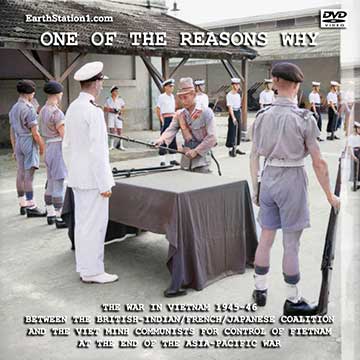
September 2, 1945: World War II: The
Pacific War (The Asia-Pacific War, The Asiatic-Pacific Theater,
The Pacific Theater Of World War II): The Asiatic-Pacific Theater:
The South-East Asian Theater Of World War II: French Indochina in
World War II: The Aftermath Of World War II: The End Of World War
II In Asia: The Decolonization of Asia: The August Revolution
(Vietnamese: Cach-Mang Thang Tam) (The August General Uprising,
The Total Uprising To Seize Power In August [Vietnamese: Tong
Khoi-nghia Gianh Chinh-Quyen Thang Tam]): The Declaration Of
Independence Of The Democratic Republic Of Vietnam (Vietnamese:
Tuyen Ngon Doc Lap Viet Nam Dan Chu Cong Hoa): -- Ho Chi Minh
establishes The Democratic Republic Of Vietnam when he reads to a
public gathering at the Ba Dinh Flower Garden (now the Ba Dinh
Square) his self-penned declaration "The Proclamation Of
Independence Of The Democratic Republic Of Vietnam". Much of
the document borrows deliberately and directly from the American
Declaration Of Independence, quoting it word-for-word in its
opening: "'All men are created equal; they are endowed by
their Creator with certain inalienable Rights; among these are
Life, Liberty, and the pursuit of Happiness.' This immortal
statement was made in the Declaration Of Independence of the
United States of America in 1776. In a broader sense, this means:
All the peoples on the earth are equal from birth, all the peoples
have a right to live, to be happy and free." On Sale Until
Midnight Tonight PT!
https://store.earthstation1.com/one-of-the-reasons-whythe-war-in-vietnam-194546-dvd-downlo194546.html
Today's
EarthStation1.com 15% (Or More!) Off Commemorative Memorial Title:
Ho Chi Minh Biography Documentary MP4 Video Download DVD
Today, September 2, 2026
September 2, 1969: #DOTD: #RIP: Ho Chi
Minh (Vietnamese: "He Who Enlightens"), also known as
Nguyen Tat Thanh, Nguyen Ai Quoc, Chua Ho, Bac Ho (Uncle Ho), Bac,
President Ho (Ho Chu Tich) and known to have used between 50 and
200 various other aliases and sobriquets, Vietnamese
Marxist-Leninist nationalist, revolutionary and statesman, one of
the founding members of the French Communist Party, Prime Minister
Of Vietnam from 1945 to 1955, President Of Vietnam from 1945 until
his death in 1969, Chairman and First Secretary of the Workers'
Party Of Vietnam (b. May 19, 1890) #dies of heart failure at his
home in Hanoi at 9:47 in the morning at the age of 79 years old.
His embalmed body is currently on display in The President Ho Chi
Minh Mausoleum in Ba Dinh Square in Hanoi, Vietnam, despite his
will which stated that he wanted to be cremated. Due to the
sensitivity of his death being on Vietnam's Independence Day, and
the outcome of the Vietnam war still in question, the North
Vietnamese government originally delayed announcing Ho's death
until the next day, September 3. A week of mourning for his death
was decreed nationwide in North Vietnam from September 4 to 11,
1969. His funeral was attended by about 250,000 people and 5,000
official guests, which included many international mourners.
Representatives from 40 countries and regions were also presented.
During the mourning period, North Vietnam received more than
22,000 condolences letters from 20 organizations and 110 countries
across the world, such as France, Ethiopia, Yugoslavia, Cuba,
Zambia, China, the USSR and many others, mostly Socialist
countries. He was not initially replaced as president; instead, a
"collective leadership" composed of several ministers
and military leaders took over, known as the Politburo. During
North Vietnam's final campaign in 1975, a famous song written by
composer Huy Thuc was often sung by PAVN soldiers: "Bac Van
Cung Chung Chau Hanh Quan" ("You Are Still Marching With
Us, Uncle Ho"). During the Fall of Saigon on April 30, 1975,
several PAVN tanks displayed a poster with those same words on it.
The day after the battle ended, on May 1 (May Day), veteran
Australian journalist Denis Warner reported that "When the
North Vietnamese marched into Saigon yesterday, they were led by a
man who wasn't there". Thus North Vietnam was ultimately
victorious against South Vietnam and its allies. Ho Chi Minh was
born Nguyen Sinh Cung in the central Vietnamese village of Kim
Lien in the Nghe An province of the French protectorate of Annam
(Trung Ky), French Indochina; following Confucian tradition, his
father gave him a new name at the age of 10: Nguyen That Thanh.
From 1911, he left French Indochina to continue his revolutionary
activities. On February 3, 1930, he founded The Communist Party Of
Vietnam (CPV) (The Vietnamese Communist Party [VCP]); in October
1930, it was transformed into The Indochinese Communist Party
(ICP), which dissolved itself on November 11, 1945. In 1941, Ho
returned to Vietnam and founded the Viet Minh umbrella group
independence movement. He then led the August Revolution against
the Japanese in August 1945, which resulted in his proclaiming the
independence of The Democratic Republic Of Vietnam and his
becoming President. He went on to lead the longest and most costly
twentieth century war, first against the French and later the
Americans. After the French returned to power the following month,
Ho's government retreated to the Viet Bac region and began
guerrilla warfare. The Viet Minh defeated the French Union in 1954
at the Battle of Dien Bien Phu, ending the First Indochina War,
and resulting in the division of Vietnam, with the Viet Minh in
control of North Vietnam, and anti-communists in control of South
Vietnam. He was a key figure in The People's Army Of Vietnam
during the Vietnam War, which lasted from 1955 to 1975. Ho
officially stepped down from power in 1965 due to health problems,
though he continued to hold the title of President until his death
in 1969. Vietnam was officially unified in 1976. Saigon, the
former capital of South Vietnam, was renamed Ho Chi Minh City in
his honor. The details of Ho Chi Minh's life before he came to
power in Vietnam are uncertain. Information on his birth and early
life is ambiguous and subject to academic debate. At least four
existing official biographies vary on names, dates, places, and
other hard facts while unofficial biographies vary even more
widely. Aside from being a politician, Ho was a writer, poet,
artist and journalist. He wrote several books, articles, and poems
in Chinese, Vietnamese, and French. On Sale Until Midnight Tonight
PT!
https://store.earthstation1.com/ho-chi-minh-biography-documentary-mp4-video-download-dvd.html
Today's
EarthStation1.com 15% (Or More!) Off Commemorative Memorial Title:
Eyes On The Prize II: America At The Racial Crossroads DVD MP4 USB
Today, September 2, 2026
September 2, 1963: Civil Rights
Movements: The American Civil Rights Movement (1954-1968):
Anti-Black Racism In The United States: School Segregation: School
Segregation In The United States: School Desegregation: School
Desegregation In The United States: The Desegregation Of Tuskegee
High School, Tuskegee, Alabama: -- Alabama governor George Wallace
makes national news when he forcibly halts public school
integration by encircling Tuskegee High School with state troopers
on the very night that The CBS Evening News was lengthened from 15
to 30 minutes to become U.S. network television's first half-hour
weeknight news broadcast and ran the story on its first broadcast.
Governor Wallace took office in January 1963 vowing segregation
now, segregation tomorrow and segregation forever. Two weeks
later, Montgomery civil rights lawyer Fred Gray filed Lee v. Macon
County Board of Education, seeking to have 14 African American
teens, led by Anthony and Henry, admitted to the all-white
Tuskegee High School. U.S. District Judge Frank M. Johnson Jr.
granted Grays petition in July. On Sept. 2, the day classes were
scheduled to start for the fall term, Wallace issued an executive
order shutting the school for a week and instructed the state
police to enforce his decree. Within days, Judge Johnson and four
other federal trial judges in Alabama jointly issued a restraining
order instructing the governor to stop interfering with the
court-ordered desegregation of public schools in Birmingham,
Mobile and Tuskegee. When Wallace ordered the Alabama National
Guard to stop any nonwhite children from entering all-white
schools, President John F. Kennedy federalized the guard and
ordered them to return to their armories. On Sale Until Midnight
Tonight PT!
https://store.earthstation1.com/eyes-on-the-prize-ii-dvd-set-4-discs-complete-2nd-seri42.html
Today's
EarthStation1.com 15% (Or More!) Off Commemorative Memorial Title:
The Soupy Sales TV Shows Video MegaSet DVD, MP4 Download, USB
Stick
Today, September 2, 2026
September 2, 1966: Aesthetics: Performing
Arts: Finales: Television Finales: American Television Finales: --
The Soupy Sales Cowgirl Jane Incident: -- The Soupy Sales Show is
canceled. ( #JCKaelin here: There are many divurgent versions of
this story listed online, but my father and I remembered this
historic (for Soupy Sales fans) event well as we were sitting
together on the couch of our Laurelton, Queens home on Friday
afternoon, September 2, 1966 -- the day "The Soupy Sales
Show" was canceled as a result of what was about to happen --
when we saw this on live TV, broadcast from atop the Empire State
Building on WNEW-TV Channel 5 New York. We recounted this shocking
and hilarious event at family get-togethers for decades ever after
until his death in 2014. It occurred at the beginning of the last
weekend of Summer '66 -- the summer that began with pop music and
ended with psychedlics, and for many teenage boys began with
pocket protectors and horn rimmed glasses and ended with nehru
jackets and beads -- and the last weekend before I first went to
school, serving thereby as a milestone of my youth and my life.
Soupy was in costume as a cowboy, making believe he was strumming
a guitar and sprechgesingen (German: "talk singing",
from Sprechgesang, "spoken singing", expressionist vocal
techniques between singing and speaking, often used in opera and
caberet, as well as in contemporary pop, rock, punk, and
alternative music since the 1960s by Bob Dylan, The B-52s, Lou
Reed, Iggy Pop and many others), when out came the words
[paraphrased] "Cowgirl Jane, Cowgirl Jane | She can't make a
cherry pie, but she sure can make my banana cream!" My father
erupted in peals of deafening laughter, and I was bewildered why,
as I didn't get the joke at that age. Dad literally fell off the
couch, doubled over with laughter, and couldn't get up off the
floor for laughing, and I was afraid because of this that he was
hurt. He dragged himself off of the floor and back onto the couch,
and I asked Dad what was so funny, and he sputtered "you're
too young to understand it". He gasped for air in-between
continued breathless chuckles, then said "I bet he gets
pulled off the air again for this", as Soupy had done at
least once before for on-air antics since being on WNEW-TV (such
as the infamous 1965 New Year's Day Incident, where he asked kids
to take their parent's "funny green pieces of paper with
pictures of U.S. presidents" and "put them in an
envelope and mail them to me and I'll send you a postcard from
Puerto Rico". I responded to my dad "Yeah, but why did
they stop the show?", and Dad kept sputtering laughs and
giggles. The screen stayed blank for about 90 seconds, then there
came on a Warner Bros. Looney Tunes cartoon, and dad erupted again
in loud laughter again, shouting "Well they did it! They took
him off the air!" I still didn't understand what was going
on, and dad still wouldn't explain it; instead, he got on the
telephone and called my Grandparents next door to tell them what
had happened. That was the last time "The Soupy Sales Show"
was broadcast ever again, until much later re-runs were aired, as
well as his 1978 "The New Soupy Sales Show". So every
March 2, in honor of National Banana Cream Pie Day, EarthStation1
MediaOutlet celebrates The Cowgirl Jane Incident because the joke
that got his show canceled was about a Banana Cream Pie, and
because his trademark sketch ending was receiving a faux cream pie
(shaving cream, actually) pie thrown in the face. So here's a
greatly loving pie in the face from me to my beloved TV kid show
host Soupy Sales for the Banana Cream Pie joke that got him pulled
off the air!" ) On Sale Until Midnight Tonight PT!
https://store.earthstation1.com/lost-soupy-sales-tv-shows-dvd.html
Today's
EarthStation1.com 15% (Or More!) Off Commemorative Memorial Title:
The Story Of Civilization: Will & Ariel Durant DVD, MP3
Download, USB
Today, September 2, 2026
September 2, 44 BC: Rome: Ancient Rome:
The Roman Republic: The Crisis Of The Roman Republic: The Orations
Of Cicero: The Philippics (Latin: Philippicae, singular
Philippica): The 1st Philippic: -- Cicero launches the first of
his Philippics (a fiery, damning speech, or tirade, delivered to
condemn a particular political actor) in the Roman Senate against
Mark Antony. He would ultimately make 14 of these philippics
between 44 and 43 BC. The term is most famously associated with
three noted orators of the ancient world: Demosthenes of ancient
Athens, Cato the Elder and Cicero of ancient Rome. The term itself
is derived from Demosthenes's speeches in 351 BC denouncing the
imperialist ambitions of Philip of Macedon, which later came to be
known as The Philippics. Cicero likened his Philippics to those
that Demosthenes delivered against Philip of Macedon. They were
delivered in the aftermath of the assassination of Julius Caesar,
during a power struggle between Caesar's supporters and his
assassins. Although Cicero was not involved in the assassination,
he agreed with it and felt that Antony should also have been
eliminated. In the Philippics, Cicero attempted to rally the
Senate against Antony, whom he denounced as a threat to the Roman
Republic. Cicero 's 1st Philippic criticised the legislation of
Mark Antony and his fellow consuls in office Publius Cornelius
Dolabella, declaring that they had acted counter to the will of
Julius Caesar, who had died on March 15th earlier in the year.
Cicero demanded that the consuls return to looking after the
welfare of the Roman people. Cicero's Second Philippic is styled
after Demosthenes' phillipic De Corona ('On the Crown'),
considered the greatest speech ever given by the greatest orator
in the world, delivered in 330 BC. The Philippics convinced the
Senate to declare Antony an enemy of the state and send an army
against him. However, the commanders were killed in battle, so the
Senate's army came under the control of Octavian. When Octavian,
Antony and Marcus Lepidus formed the Second Triumvirate, Antony
insisted that they proscribe Cicero in revenge for the Philippics.
Cicero was hunted down and killed soon after. On Sale Until
Midnight Tonight PT!
https://store.earthstation1.com/story-of-civilization-will-amp-ariel-durant-mp3-dvd-11-audiobo311.html
Today's
EarthStation1.com 15% (Or More!) Off Commemorative Memorial Title:
The Genius That Was China Documentary Series DVD, Download, USB
Drive
Today, September 2, 2026
September 2, 1363: Greatest Naval
Battles: The Mongols: The Mongol Empire: The Royal House Of
Borjigin: The Chinese Dynasties (The Dynasties Of China, The
Chinese Monarchy): The Yuan Dynasty (Chinese: Yuanchao) (The Great
Yuan): The Red Turban Rebellions (Chinese: Hongjin Qiyi): The
Battle Of Lake Poyang (Chinese: Poyang Hu Zhizhan): -- The largest
naval battle in history in terms of personnel, the five-week
Battle Of Lake Poyang (August 30-October 4, 1363), sees the tide
of battle turn against the Chen Han when they were forced to
withdraw from Nanchang, the capital and largest city of Jiangxi
Province, by the Ming. A reported 850,000 sailors and soldiers
involved; a rebel force of Ming (a han people of the Yellow River
Basin), said to be 200,000 strong, commanded by Zhu Yuanzhang, met
a rebel force of Chen Han (a middle Yangtze dynasty), claimed to
be 650,000-strong, commanded by the Chen Han Dynasty founder Chen
Youliang. The battle was fought to decide who would supplant the
Yuan dynasty during the Red Turban Rebellions, which were
uprisings against the Yuan Dynasty that had been established in
1351 by the Mongol leader of Borjigin clan Kublai Khan, uprisings
which eventually led to the overthrow of Mongol rule in China and
thereby the fall of the Yuan dynasty in 1368 with the
establishment of Zhu Yuanzhang as Emperor Hongwu, the first
Emperor of the Ming Dynasty. Chen Youliang besieged Nanchang with
a large fleet on Lake Poyang, the largest freshwater lake in
China, and Zhu Yuanzhang met his force with a smaller fleet. After
an inconclusive engagement exchanging fire, Zhu employed fire
ships to burn and destroy the Han fleet of Louchuan ships, tower
ships central to Han fleets used as floating fortresses, equipped
for boarding and attacking enemy vessels and with siege weapons
such as traction trebuchets, a type of catapult that uses a long
arm to throw a projectile, for ranged combat. This was the last
major battle of the rebellion prior to the rise of the Ming
dynasty. On August 30 , the forces of Chen Han conducted a major
amphibious assault on Nanchang with a hundred vessels and several
hundred troops. The town of Nanchang was strategically located to
guard Lake Poyang, which connected the Yangtze River with other
river basins via the Gan, Xin, and Xiu rivers. During the early
1360s Zhu Yuanzhang held key garrisons on the lake and
administered them from Nanjing 560 kilometers downriver. Chen
Youliang tried to deposit his troops on the city walls with "tower
ships". This proved futile as the city defenders simply moved
the walls back and Chen was forced to personally lead an assault
on the city gates. They were repelled with a barrage of cannonfire
and driven back. After this failure, Chen set up a blockade,
determined to starve out the defenders, but a small fishing boat
managed to slip out and reached Nanjing in time to warn Zhu
Yuanzhang. Zhu Yuanzhang's fleet arrived at Poyang Lake on August
29 with a force only a third the size of Chen's army. According to
one Ming source, Zhu's forces arrived armed with "fire bombs,
fire guns, fire arrows, fire seeds [probably grenades], large and
small fire lances, large and small 'commander' fire-tubes, large
and small iron bombs, rockets." This shows that older
gunpowder weapons co-existed alongside guns, and proto-guns such
as fire lances were not supplanted until after early Ming. A new
weapon called the "No Alternative" was also mentioned.
The No Alternative was "made from a circular reed mat about
five inches around and seven feet long that was pasted over with
red paper and bound together with silk and hemp- stuffed inside it
was gunpowder twisted in with bullets and all kinds of
[subsidiary] gunpowder weapons." It was hung from a pole on
the foremast, and when an enemy ship came into close range, the
fuse was lit, and the weapon would supposedly fall onto the enemy
ship, at which point things inside shot out "and burned
everything to bits, with no hope of salvation." On August 30,
Zhu's fleet engaged Chen's under orders to "get close to the
enemy's ships and first set off gunpowder weapons (???), then bows
and crossbows, and finally attack their ships with short range
weapons." Fire bombs were hurled using naval trebuchets and
the Ming succeeded in "burning twenty or more enemy vessels
and killing or drowning many enemy troops," but their own
flagship also caught fire and hit a sandbar, forcing them to
withdraw. On August 31, the Ming rammed the enemy fleet with fire
ships. While guns were used during the battle, ultimately they
were not pivotal to success, and the battle was won using
incendiary weapons. On September 2, the two fleets engaged in
battle again, but the tide turned on Chen's forces, and they were
forced to withdraw. Afterwards, Zhu's fleet settled into a
blockade for another month until they employed fire ships again on
October 4, destroying the rest of Chen's fleet. Chen Youliang was
killed when an arrow struck his head. Chen Youliang was succeeded
by his son, Chen Li, who surrendered to Zhu in 1364. The Ming
victory here cemented their position as the leading rebel group.
Five years later, the Ming would overthrow the Yuan and take
command over China. Zhu Yuanzhang then became the first Emperor of
the Ming Dynasty as Hongwu. On Sale Until Midnight Tonight PT!
https://store.earthstation1.com/the-genius-that-was-china-dvd-tv-documentary-series-2-disc-se2.html
Today's
EarthStation1.com 15% (Or More!) Off Commemorative Memorial Title:
George B. McClellan American Civil War General MP4 Download Or DVD
Today, September 2, 2026
September 2, 1862: The American Civil War
(The Civil War, The War Between The States): The Eastern Theater
Of The American Civil War: The Second Battle Of Bull Run (The
Battle Of Second Manassas): -- In response to Union General John
Pope's disastrous defeat at the Second Battle Of Bull Run,
President Abraham Lincoln reluctantly restores Union General
George B. McClellan to full command of The Army Of The Potomac.
Pope was relieved of command on September 12, and his Union Army
Of Virginia was merged into The Army Of The Potomac as it marched
into Maryland under McClellan. The Second Battle Of Bull Run,
known as The Battle Of Second Manassas in the South, was a
three-day battle that was the culmination of the Northern Virginia
Campaign, fought in Prince William County, Virginia by Confederate
Gen. Robert E. Lee's Army Of Northern Virginia against Union Maj.
Gen. John Pope's Army of Virginia, a battle of much larger scale
and numbers than that of The First Battle Of Bull Run (or The
Battle Of First Manassas) fought on July 21, 1861 fought on the
same ground. Following a wide-ranging flanking march, Confederate
Maj. Gen. Thomas J. "Stonewall" Jackson captured the
Union supply depot at Manassas Junction, threatening Pope's line
of communications with Washington, D.C. Withdrawing a few miles to
the northwest, Jackson took up strong concealed defensive
positions on Stony Ridge and awaited the arrival of the wing of
Lee's army commanded by Maj. Gen. James Longstreet. On August 28,
1862, Jackson attacked a Union column just east of Gainesville, at
Brawner's Farm, resulting in a stalemate but successfully getting
Pope's attention. On that same day, Longstreet broke through light
Union resistance led by General James B. Ricketts and Colonel
Percy Wyndham in the Battle of Thoroughfare Gap, also known as
Chapman's Mill, and approached the battlefield. Pope became
convinced that he had trapped Jackson and concentrated the bulk of
his army against him. On August 29, Pope launched a series of
assaults against Jackson's position along an unfinished railroad
grade. The attacks were repulsed with heavy casualties on both
sides. At noon, Longstreet arrived on the field from Thoroughfare
Gap and took position on Jackson's right flank. On August 30, Pope
renewed his attacks, seemingly unaware that Longstreet was on the
field. When massed Confederate artillery devastated a Union
assault by Maj. Gen. Fitz John Porter's V Corps, Longstreet's wing
of 25,000 men in five divisions counterattacked in the largest
simultaneous mass assault of the war. The Union left flank was
crushed and the army was driven back to Bull Run. Only an
effective Union rear guard action prevented a replay of the First
Manassas defeat. Pope's retreat to Centreville was nonetheless
precipitous. It was a significant tactical victory for the
Confederates and was another blow to Union morale. Success in this
battle emboldened Lee to initiate the ensuing Maryland Campaign,
Lee's first invasion of the North. On Sale Until Midnight Tonight
PT!
https://store.earthstation1.com/george-b-mcclellan-american-civil-war-general-mp4-download-or-dvd.html
Today's
EarthStation1.com 15% (Or More!) Off Commemorative Memorial Title:
The Civil War: A Video Image History JPG Set + MPG DVD, Download,
USB
Today, September 2, 2026
September 1-2, 1864: The American Civil
War (The Civil War, The War Between The States): The Eastern
Theater Of The American Civil War: The Atlanta Campaign: The
Battle Of Atlanta: The Fall Of Atlanta: -- Sherman's Union forces
enter Atlanta, a day after the Confederate defenders flee the
city, ending the Atlanta Campaign. "Atlanta is ours, and
fairly won," Gen. William T. Sherman telegraphed President
Lincoln. Due to the success of the August 31 - September 1, 1864
Battle Of Jonesborough (modern name Jonesboro), which took place
when Union forces led by General William T. Sherman launched an
assault on Atlanta, the Confederate Army General John Bell Hood
orders the evacuation of Atlanta, ending a four-month siege by
General Sherman. Two Union armies, the Army Of The Tennessee and
the Army of the Cumberland, led by Maj. Gen. William T. Sherman,
maneuvered to draw the Army of Tennessee (led by John Bell Hood)
away from their defenses at Atlanta, Georgia, where it could be
destroyed. Although Hood's army was not destroyed, the city of
Atlanta was abandoned and then occupied by Union troops for the
rest of the war, resulting in The Fall Of Atlanta, which had
far-reaching political as well as military effects on the course
of the war. The Battle Of Atlanta was a battle of the Atlanta
Campaign fought during the American Civil War on July 22, 1864,
just southeast of Atlanta, Georgia. Continuing their summer
campaign to seize the important rail and supply center of Atlanta,
Union forces commanded by William Tecumseh Sherman overwhelmed and
defeated Confederate forces defending the city under John Bell
Hood. Union Maj. Gen. James B. McPherson was killed during the
battle. Despite the implication of finality in its name, the
battle occurred midway through the campaign, and the city did not
fall until September 2, 1864, after a Union siege and various
attempts to seize railroads and supply lines leading to Atlanta.
After taking the city, Sherman's troops headed south-southeastward
toward Milledgeville, the state capital, and on to Savannah with
the March to the Sea. On Sale Until Midnight Tonight PT!
https://store.earthstation1.com/the-civil-war-a-video-image-history-photo-cd-mpg-video-cdrom.html
Today's
EarthStation1.com 15% (Or More!) Off Commemorative Memorial Title:
The World At War 1942 How WWII Started Documentary DVD, Download,
USB
Today, September 2, 2026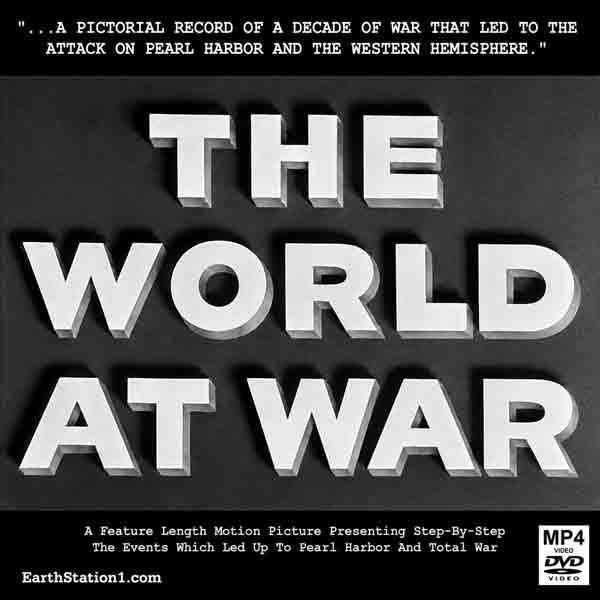
September 2, 1939: The European Civil
War: World War II: The Second European War (The European Theater
Of World War II): The Invasion Of Poland (The September Campaign,
The Polish Campaign, The War Of Poland Of 1939, The Polish
Defensive War Of 1939): The Free City Of Danzig (German: Freie
Stadt Danzig; Polish: Wolne Miasto Gdansk): The Annexation Of The
Free City Of Danzig By Nazi Germany: -- The Free City Of Danzig
(now Gdansk, Poland) is annexed by Nazi Germany. The Free City Of
Danzig was a semi-autonomous city-state that existed between 1920
and 1939, consisting of the Baltic Sea port of Danzig (Gdansk) and
nearly 200 towns and villages in the surrounding areas. It was
created on 15 November 1920 in accordance with the terms of
Article 100 (Section XI of Part III) of the 1919 Treaty Of
Versailles after the end of World War I. The Free City included
the city of Danzig and other nearby towns, villages, and
settlements that were primarily inhabited by Germans. As the
Treaty stated, the region was to remain separated from post-World
War I Germany (the Weimar Republic) and from the newly independent
nation of the Second Polish Republic ("interwar Poland"),
but it was not an independent state. The Free City was under
League Of Nations protection and put into a binding customs union
with Poland. Poland was given certain rights pertaining to
communication, the railways and port facilities in the city. The
Free City was created in order to give Poland access to a
well-sized seaport. The city's population of 410,000 was 98%
German, 1% was Polish and 1% others. The German population deeply
resented being separated from Germany. Poland, despite having been
awarded generous rights in the Free City nevertheless went ahead
and built, in 1921, with French loans, a completely new port some
miles round Danzig Bay on territory awarded them in 1919, laying
new railway lines to it also, removing the commerce which would
normally have moved through Danzig. By 1933 the commerce passing
through Gydnia exceeded that of Danzig. Notwithstanding this,
Poland refused to relinquish the trading etc rights awarded to
her, further alienating the Danzigers. By 1936, the city's Senate
had a majority of local Nazis. Due to anti-Semitic persecution and
oppression, many Jews fled. Agitation to rejoin Germany was
stepped up. German policy immediately after the Munich Conference
in October 1938 conspired to bring this rejoining about when
German Minister of Foreign Affairs Joachim von Ribbentrop demanded
the incorporation of the Free City into the Reich. From then on,
Germany made escalating demands upon Poland regarding Danzig in an
effort to bring about a conflict, ultimately resulting in the
beginning of World War II in Europe with The Battle Of
Westerplatte, when at between 4:45 and 4:48 a.m. the German
battleship SMS Schleswig-Holstein fires point-blank at the Polish
Military Transit Depot (Polish: Wojskowa Skladnica Tranzytowa, or
WST) on the Westerplatte peninsula in the harbor of the Free City
of Danzig with the support of the German army and Danzig police.
After the German Invasion Of Poland in 1939, the Nazis abolished
the Free City and incorporated the area into the newly formed
Reichsgau of Danzig-West Prussia. The Nazis classified the Poles
and Jews living in the city as subhumans, subjecting them to
discrimination, forced labor, and extermination. Many were sent to
their deaths at Nazi concentration camps, including nearby
Stutthof (now Sztutowo, Poland). During the city's conquest by the
Soviet Army in the early months of 1945, a substantial number of
citizens fled or were killed. After the war, many surviving
Germans were expelled to West or East Germany as members of the
pre-war Polish ethnic minority started returning and as new Polish
settlers began to come. Due to these events, Gdansk suffered
severe underpopulation and did not recover until the late 1950s.
In 1945 the city officially became part of Poland as a consequence
of the Potsdam Agreement. On Sale Until Midnight Tonight PT!
https://store.earthstation1.com/the-world-at-war-dvd-1942-motion-pic1942.html
Today's
EarthStation1.com 15% (Or More!) Off Commemorative Memorial Title:
War Props: The Lockheed C130 Hercules DVD, MP4 Download, USB Drive
Today, September 2, 2026
September 2, 1958: Aviation: The History
Of Aviation: The History Of Military Aviation: Aviation Incidents
And Accidents: The Cold War: The Cold War (1953-1962): The 1958
C-130 Shootdown Incident: -- An United States Air Force
C-130A-II-LM Hercules reconnaissance aircraft is shot down by
Soviet MiG-17 fighters over Yerevan, Armenia when it intruded into
Soviet airspace during a reconnaissance mission along the
Turkish-Armenian border. All crew members are killed. The Lockheed
RC-130 Hercules (s/n 56-0528) from the 7406th Support Squadron
(now the 7499th Support Group) departed Incirlik Airbase in Turkey
to fly a course parallel to the Soviet frontier, but not approach
the border closer than 100 miles (160 km). The crew reported
passing over Trabzon in Turkey at 25,500 feet (7,800 m) and then
acknowledged a weather report from Trabzon, but that was the last
communication received from the flight. It was later intercepted
and shot down by four Soviet MiG-17s 34 mi (55 km; 30 nmi)
north-west of Yerevan. The six flight crew were confirmed dead
when their remains were repatriated to the United States, but the
11 intelligence-gathering personnel on board have never been
acknowledged by Soviet / Russian authorities. After the fall of
the Soviet Union a US excavation team found hundreds of skeletal
fragments; two remains were identified. A group burial of the 17
crew remains was at Arlington National Cemetery. The exact cause
of why the aircraft strayed into Soviet airspace is unknown, but
according to the Aviation Safety Network, the crew may have
confused a radio beacon in the USSR with similar frequencies to
the Turkish beacons they were briefed to use, or it may have been
a deliberate maneuver to obtain better data. On Sale Until
Midnight Tonight PT!
https://store.earthstation1.com/war-props-the-lockheed-c130-hercules-130.html
Today's
EarthStation1.com 15% (Or More!) Off Commemorative Memorial Title:
The Second Russian Revolution TV Series DVD, Video Download, USB
Drive
Today, September 2, 2026
September 2, 1987: The Aftermath Of World
War II: The Cold War: The Cold War (1985-1991) (The End Of The
Cold War): The Dissolution Of The Soviet Union: The Revolutions Of
1989 (The Fall Of Nations, The Autumn Of Nations, The Fall Of
Communism): The Eastern Bloc (The Communist Bloc, The Socialist
Bloc, The Soviet Bloc): Mathias Rust's Aircraft Landing In Red
Square: -- In Moscow, the trial begins for 19-year-old pilot
Mathias Rust, who flew his Cessna airplane into Red Square in May.
On May 28, 1987, the 18-year-old West German pilot flew from
Helsinki, Finland, to Moscow, being tracked several times by
Soviet air defence and interceptor aircraft. The Soviet fighters
did not receive permission to shoot him down, and his aeroplane
was mistaken for a friendly aircraft several times. He landed on
Bolshoy Moskvoretsky Bridge, next to Red Square near the Kremlin
in the capital of the Soviet Union. Rust said he wanted to create
an "imaginary bridge" to the East, and that his flight
was intended to reduce tension and suspicion between the two Cold
War sides. Rust's flight through a supposedly impenetrable air
defence system had a great effect on the Soviet military and led
to the dismissal of many senior officers, including Minister of
Defence Marshal of the Soviet Union Sergei Sokolov and the
Commander-in-Chief of the Soviet Air Defence Forces, former World
War II fighter ace pilot Chief Marshal Alexander Koldunov. The
incident aided Mikhail Gorbachev in the implementation of his
reforms, by allowing him to dismiss numerous military officials
opposed to his policies. Rust was sentenced to four years in
prison for violation of border crossing and air traffic
regulations, and for provoking an emergency situation upon his
landing. After 14 months in prison, he was pardoned by Andrei
Gromyko, the Chairman of the Presidium of the Supreme Soviet, and
released. Rust's return to Germany on August 3, 1988 was
accompanied by huge media attention, but he did not talk to the
assembled journalists; his family had sold the exclusive rights to
the story to the German magazine Stern for DM100,000. He reported
that he had been treated well in the Soviet prison. Journalists
described him as "psychologically unstable and unworldly in a
dangerous manner". William E. Odom, former director of the
U.S. National Security Agency and author of The Collapse of the
Soviet Military, says that Rust's flight irreparably damaged the
reputation of the Soviet military. This enabled Gorbachev to
remove many of the strongest opponents to his reforms. Minister of
Defence Sergei Sokolov and the head of the Soviet Air Defence
Forces Alexander Koldunov were dismissed along with hundreds of
other officers. This was the biggest turnover in the Soviet
military since Stalin's purges 50 years earlier. Rust's rented
Reims Cessna F172P (serial #F17202087), registered D-ECJB, was
sold to Japan where it was exhibited for several years. In 2008 it
was returned to Germany and was placed in the Deutsches
Technikmuseum in Berlin. His later life has been turbulent. While
doing his obligatory community service (Zivildienst) in a West
German hospital in 1989, Rust stabbed a female co-worker who had
rejected him. The victim barely survived. He was convicted for
injuring her and sentenced to two and a half years in prison, but
was released after 15 months. Since then he has lived a fragmented
life, describing himself as a "bit of an oddball". After
being released from court, he converted to Hinduism in 1996 to
become engaged to a daughter of an Indian tea merchant. In 2001,
he was convicted of stealing a cashmere pullover and ordered to
pay a fine of DM10,000, which was later reduced to DM600.A further
brush with the law came in 2005, when he was convicted of fraud
and had to pay 1,500 EU for stolen goods. In 2009 Rust described
himself as a professional poker player. In 2012, he described
himself as an analyst at a Zurich-based investment bank. In
October 2015, The Hindu published an interview with Mathias Rust
to mark the 25th anniversary of German Reunification. Mathias Rust
surmised that institutional failures in Western countries to
preserve moral standards and uphold the primacy of democratic
ideals was creating mistrust between peoples and governments.
Pointing to the genesis of a New Cold War between Russia and the
Western powers, Mathias Rust suggested that India should tread
with caution and avoid entanglement: "India will be better
served if it follows a policy of neutrality while interacting with
EU member countries as the big European powers at present are
following the foreign policy of the U.S. unquestioningly". He
claimed: "Governments have been dominated by the corporate
entities and citizens have ceased to matter in public policy".
Because Rust's flight seemed like a blow to the authority of the
Soviet regime, it was the source of numerous jokes and urban
legends. For a while after the incident, Red Square was jokingly
referred to by Muscovites as Sheremetyevo-3 (Sheremetyevo-1 and -2
being the two terminals at Moscow's main international airport).
At the end of 1987, the police radio code used by law enforcement
officers in Moscow was allegedly updated to include a code for an
aircraft landing. On Sale Until Midnight Tonight PT!
https://store.earthstation1.com/the-second-russian-revolution-6-dvd-set-complete-tv-serie6.html
Today's
EarthStation1.com 15% (Or More!) Off Commemorative Memorial Title:
Timeline Middle Ages TV Newscast Series + Bonus MP4 Video Download
DVD
Today, September 2, 2026
September 2, 1192: Religion: The History
Of Religion: Abrahamic Religions: Christianity: The History Of
Roman Catholicism: The Latin Church (Latin: Ecclesia Latina): The
Middle Ages (The Medieval Period, The Mediaeval Period): The
Crusades: The Third Crusade (1189-1192): The Treaty Of Jaffa (The
Treaty Of Ramla, The Treaty Of 1192): -- Richard I (Richard The
Lionheart), King Of England, and Saladin, Sultan Of Egypt and
Sultan Of Syria, sign a truce in the aftermath the July-August
1192 Battle Of Jaffa, a decisive encounter that forced Saladin to
negotiate an end to immediate hostilities, and evinced both the
determined spirit of Saladin and the courage and tactical skill of
Richard. The treaty, negotiated with the help of the Crusader
ruler of The Kingdom Of Jerusalem Count Balian Of Ibelin,
guaranteed a three-year truce between the two armies, and
effectively ended the Third Crusade. Although the Crusaders did
not regain possession of Jerusalem, Christian pilgrims were
permitted entry into the city, and the Crusaders were able to
retain control of a sizable strip of land stretching from Beirut
to Jaffa, while the Crusader fortifications of the port city of
Ascalon were to be demolished and the town returned to Saladin.
Neither Saladin nor Richard were fond of the overall accord, but
each had little choice. The Islamic ruler had been weakened by the
trials and expense of war, and both had to deal with threats to
his kingdom at home, with Richard departing Acre on October 9,
1192 to return to England which was falling apart with his
absence. The Third Crusade (1189-1192), was an attempt by European
Christian leaders to reconquer the Holy Land following the capture
of Jerusalem by the Ayyubid sultan, Saladin, in 1187. Also known
as the Kings' Crusade for its main leaders, kings Richard I of
England and Philip II of France (echoing the name "Princes'
Crusade" given to the successful First Crusade), the campaign
was largely successful in capturing the important cities of Acre
and Jaffa, and reversing most of Saladin's conquests, but it
failed to re-capture Jerusalem. After the failure of the Second
Crusade, the Zengid dynasty controlled a unified Syria and engaged
in a conflict with the Fatimid rulers of Egypt. The Egyptian and
Syrian forces were ultimately unified under Saladin, who employed
them to reduce the Christian states and recapture Jerusalem in
1187. Spurred by religious zeal, King Henry II Of England and King
Philip II of France (known as Philip Augustus) ended their
conflict with each other to lead a new crusade. The death of Henry
in 1189, however, meant the English contingent came under the
command of his successor, King Richard I of England. The elderly
German Emperor Frederick Barbarossa also responded to the call to
arms, leading a massive army across Anatolia, but he drowned in a
river in Asia Minor on 10 June 1190 before reaching the Holy Land.
His death caused tremendous grief among the German Crusaders, and
most of his troops returned home. After the Crusaders had driven
the Muslims from Acre, Philip in company with Frederick's
successor, Leopold V, Duke of Austria (known as Leopold the
Virtuous), left the Holy Land in August 1191. On 2 September 1192,
Richard and Saladin finalized a treaty granting Muslim control
over Jerusalem but allowing unarmed Christian pilgrims and
merchants to visit the city. Richard departed the Holy Land on 9
October. The successes of the Third Crusade allowed the Crusaders
to maintain considerable states in Cyprus and on the Syrian coast.
The failure to re-capture Jerusalem inspired the subsequent Fourth
Crusade, but the city would only be regained, and then briefly, by
the Sixth Crusade, in 1229. On Sale Until Midnight Tonight PT!
https://store.earthstation1.com/timeline-tv-series-on-the-middle-ages-in-tv-newscast-format-2-dvd-se2.html
Today's
EarthStation1.com 15% (Or More!) Off Commemorative Memorial Title:
50 Years Together: Channel 2 And You WCBS-TV (1991) DVD MP4 USB
Drive
Today, September 2, 2026
September 2, 1963: The History Of
Broadcasting: The History Of Television Broadcasting: Television
Journalism: The History Of Television Journalism: Premieres:
Television Premieres: United States Television Premieres: CBS
Evening News: -- U.S. network television's first half-hour
weeknight news broadcast premieres when The CBS Evening News is
lengthened from 15 to 30 minutes. Walter Cronkite became anchor of
the program titled "Walter Cronkite With The News" on
April 16, 1962. On September 2, 1963, the program, retitled "CBS
Evening News", became the first half-hour weeknight news
broadcast of network television. and was moved to 6:30 p.m.
Eastern time. Exactly one week later on September 9, 1963, the
Huntley-Brinkley Report on NBC also expanded to 30 minutes. As
before the change, some CBS affiliates (including flagship
owned-and-operated station WCBS-TV in New York City) had the
option of carrying a later edition, this time scheduled for 7:00
p.m. Eastern Time. NBC also allowed this practice for the
Huntley-Brinkley Report, with ABC later following it for the ABC
Evening News (now ABC World News Tonight). The networks ended this
practice after 1971, although some affiliates - mostly in larger
markets - continued to carry the national newscasts at 7:00 p.m.
Eastern Time on a half-hour tape delay. On Sale Until Midnight
Tonight PT!
https://store.earthstation1.com/50-years-together-channel-2-amp-you-dvd-wcbstv-new-y502.html
Today's
EarthStation1.com 15% (Or More!) Off Commemorative Memorial Title:
The French Revolution Series + Irish Rebellion & You Are There
MP4 DVD
Today, September 2, 2026
September 2, 1792: The Age Of
Enlightenment (The Enlightenment, The Age Of Reason): The Age Of
Revolution: The Atlantic Revolutions: The French Revolution:
Anti-Catholicism In France: Massacres Of The French Revolution:
The September Massacres (September 2-6, 1792): -- Rampaging mobs
slaughter three Roman Catholic Church bishops, more than two
hundred priests, and prisoners believed to be royalist
sympathizers. The September Massacres were a wave of killings in
Paris and other cities from September 2-7, 1792, during the French
Revolution. There was a fear that foreign and royalist armies
would attack Paris and that the inmates of the city's prisons
would be freed and join them. Radicals called for preemptive
action. The action was undertaken by mobs of National Guardsmen
and some federes; it was tolerated by the city government, the
Paris Commune, which called on other cities to follow suit. By
September 6, half the prison population of Paris had been
summarily executed: some 1200 to 1400 prisoners. Of these, 233
were nonjuring Catholic priests who refused to submit to the Civil
Constitution of the Clergy. However, the great majority of those
killed were common criminals. The massacres were repeated in many
other French cities. No one was prosecuted for the killings, but
the political repercussions first injured the Girondists (who
seemed too moderate) and later the Jacobins (who seemed too
bloodthirsty). On Sale Until Midnight Tonight PT!
https://store.earthstation1.com/the-french-revolution-dvd-3-part-tv-documentary-serie3.html
Today's
EarthStation1.com 15% (Or More!) Off Commemorative Memorial Title:
The Struggles For Poland TV Series + Bonus MP4 Video Download DVD
Set
Today, September 2, 2026
August 31-September 2, 1920: The
Aftermath Of World War I: 20th Century Revolutions: The
Revolutions Of 1917-1923: The Interwar Period (The Interbellum,
Between The Wars): The Russian Revolution: The Russian Civil War:
The Western Front Of The Russian Civil War (Western Front
(RSFSR)): The Ukrainian War Of Independence (The Ukrainian-Soviet
War): The Lithuanian Wars Of Independence, The Freedom Struggles):
The Latvian War Of Independence (Latvia's Freedom Battles, The
Latvian War Of Liberation): The Polish-Soviet War: The Battle Of
Komarow (The Battle Of Zamosc Ring): -- The last great battle of
any significance in which cavalry was used as such and not as
mounted infantry, and one of the largest cavalry battles since
1813, ends in a decisive Polish victory and a disaster for the
Soviet 1st Cavalry Army, which sustained heavy casualties and
barely avoided being surrounded and destroyed. After the battle,
the morale of the 1st Cavalry Army collapsed, and it no longer
remained an effective fighting force. On Sale Until Midnight
Tonight PT!
https://store.earthstation1.com/the-struggles-for-poland-dvd-set-all-9-shows-5-dis95.html
Today's
EarthStation1.com 15% (Or More!) Off Commemorative Memorial Title:
Chuck McCann 1960s New York City Kids TV Shows DVD, Download, USB
Today, September 2, 2026
September 2, 1934: #BOTD: #HBD! Chuck
McCann, American stage, film, television, and voice actor, and
television personality (d. April 8, 2018) is #born Charles John
Thomas McCann in Brooklyn, New York. He was known to a generation
of children who grew up watching his children' shows in the New
York City metropolitan area during the 1960s, having worked his
way up to regional star status by apprenticing on a number of
other children' shows, such as Rootie Kazootie (the show on which
he met his one-time puppeteer and sidekick, Paul Ashley), Captain
Kangaroo and Sandy Becker. The best-selling The First Family, an
early '60s LP record album which lampooned the newly elected
President John F. Kennedy and his family, included McCann among
its voices, and he was also included in David Frye' I Am The
President comedy album lampoon of Richard Nixon. Chuck McCann died
of congestive heart failure in Cedars-Sinai Medical Center in Los
Angeles at the age of 83. He was cremated and his remains are in
Forest Lawn Memorial Park in Hollywood Hills, California. On Sale
Until Midnight Tonight PT!
https://store.earthstation1.com/chuck-mccann-dvd-dual-layer-tv-shows-1960s-new-york-city-kid1960.html
Today's
EarthStation1.com 15% (Or More!) Off Commemorative Memorial Title:
The History Of Jazz A Video Retrospective DVD, MP4 Download, USB
Drive
Today, September 2, 2026
September 2, 1928: #BOTD: #HBD! Horace
Silver, African American jazz pianist, composer, and arranger,
particularly in the hard bop style that he helped pioneer in the
1950s (d. June 18, 2014) is #born Horace Ward Martin Tavares
Silver in Norwalk, Connecticut. After playing tenor saxophone and
piano at school in Connecticut, Horace Ward Martin Tavares Silver
got his break on piano when his trio was recruited by Stan Getz in
1950. Silver soon moved to New York City, where he developed a
reputation as a composer and for his bluesy playing. Frequent
sideman recordings in the mid-1950s helped further, but it was his
work with the Jazz Messengers, co-led by Art Blakey, that brought
both his writing and playing most attention. Their Horace Silver
and the Jazz Messengers album contained Silver's first hit, "The
Preacher". After leaving Blakey in 1956, Silver formed his
own quintet, with what became the standard small group line-up of
tenor saxophone, trumpet, piano, bass, and drums. Their public
performances and frequent recordings for Blue Note Records
increased Silver's popularity, even through changes of personnel.
His most successful album was Song for My Father, made with two
iterations of the quintet in 1963 and 1964. Several changes
occurred in the early 1970s: Silver disbanded his group to spend
more time with his wife and to concentrate on composing; he
included lyrics in his recordings; and his interest in
spiritualism developed. The last two of these were often combined,
resulting in commercially unsuccessful releases such as The United
States of Mind series. Silver left Blue Note after 28 years,
founded his own record label, and scaled back his touring in the
1980s, relying in part on royalties from his compositions for
income. In 1993, he returned to major record labels, releasing
five albums before gradually withdrawing from public view because
of health problems. As a player, Silver transitioned from bebop to
hard bop by stressing melody rather than complex harmony, and
combined clean and often humorous right-hand lines with darker
notes and chords in a near-perpetual left-hand rumble. His
compositions similarly emphasized catchy melodies, but often also
contained dissonant harmonies. Many of his varied repertoire of
songs, including "Doodlin'", "Peace", and
"Sister Sadie", became jazz standards that are still
widely played. His considerable legacy encompasses his influence
on other pianists and composers, and the development of young jazz
talents who appeared in his bands over the course of four decades.
Horace Silver dieds of natural causes in New Rochelle, New York,
aged 85. His burial details are not publicly disclosed. On Sale
Until Midnight Tonight PT!
https://store.earthstation1.com/the-history-of-jazz-by-billy-taylor-parts-i-amp-ii-dvd.html
Today's
EarthStation1.com 15% (Or More!) Off Commemorative Memorial Title:
Let It Be (1970) Beatles Final Film DVD, Video Download, Flash
Drive
Today, September 2, 2026
September 2, 1946: #BOTD: #HBD! Billy
Preston, African American singer, songwriter, keyboardist, and
actor, child prodigy who was entirely self-taught and never had a
music lesson, whose musical works encompassed R & B, rock,
soul, funk, and gospel, one of only two non-Beatle musicians
(along with Tony Sheridan) to be given a credit on a Beatles
recording at the band's request; the group's 1969 single "Get
Back" was credited as "The Beatles with Billy Preston"
(d. June 6, 2006) is #born William Everett Preston in Houston,
Texas. Preston was a top session keyboardist in the 1960s, during
which he backed artists such as Little Richard, Sam Cooke, Ray
Charles, the Everly Brothers, Reverend James Cleveland, the
Beatles and the Rolling Stones. He gained attention as a solo
artist with hit singles such as "That's the Way God Planned
It", the Grammy-winning "Outa-Space", "Will It
Go Round In Circles", "Space Race", "Nothing
From Nothing", and "With You I'm Born Again".
Additionally, Preston co-wrote "You Are So Beautiful",
which became a #5 hit for Joe Cocker. Preston is the only
non-Beatle musician to be given a credit on a Beatles recording at
the band's request; the group's 1969 single "Get Back"
was credited as "The Beatles with Billy Preston". He
continued to record and perform with George Harrison after the
Beatles' breakup, along with other artists such as Eric Clapton,
and the Rolling Stones on many of the group's albums and tours
during the 1970s. Billy Preston died aged 59 in Scottsdale,
Arizona in a coma caused by respiratory failure. Preston's funeral
was held June 21, 2006. At the funeral, which lasted almost three
hours, Joe Cocker sang, Little Richard reminisced, and a brass
band played a version of "Amazing Grace". Other musical
performers included The Temptations' lead vocalist Ali Woodson and
singer Merry Clayton. A gospel choir, clad in bright red, sang
throughout. The mourners also heard letters written by Paul
McCartney, the Rolling Stones, Eric Clapton, and others who had
toured and recorded with Preston. He is buried at Inglewood Park
Cemetery in Inglewood, California. On Sale Until Midnight Tonight
PT!
https://store.earthstation1.com/let-it-be-1970-the-beatles-dvd-download-usb-flashd1970.html
Today's
EarthStation1.com 15% (Or More!) Off Commemorative Memorial Title:
Vincent Van Gogh TV Series DVD, Video Download, USB Flash Drive
Today, September 2, 2026
September 2, 1929: #BOTD: #HBD! Victor
Spinetti, Welsh actor, author, poet, and raconteur, who appeared
in dozens of films and stage plays throughout his 50-year career,
including the three 1960s Beatles films A Hard Day's Night, Help!,
and Magical Mystery Tour (d. June 19, 2012) is #born Vittorio
Giorgio Andre Spinetti in Cwm, Blaenau Gwent, Wales. He and was
educated at Monmouth School and the Royal Welsh College of Music &
Drama in Cardiff, of which he became a Fellow. After various
menial jobs, Spinetti pursued a stage career and was closely
associated with Joan Littlewood's Theatre Workshop. Among the
productions were Fings Ain't Wot They Used T'Be and Oh, What a
Lovely War! (1963), which transferred to Broadway and for which he
won a Tony Award. Spinetti's film career developed simultaneously;
his dozens of film appearances included Zeffirelli's The Taming of
the Shrew, Under Milk Wood, The Return of the Pink Panther and
Under the Cherry Moon. During his later career, Spinetti acted
with the Royal Shakespeare Company, in such roles as Lord
Foppington in The Relapse and the Archbishop in Richard III, at
Stratford-upon-Avon; and, in 1990, he appeared in The Krays. In
2008 he appeared in a one-man show, A Very Private Diary, which
toured the UK as A Very Private Diary ... Revisited!, recounting
his life story. Victor Spinetti died in the morning of prostate
cancer at Monnow Vale Integrated Health and Social Care Facility
in Monmouth, Wales, aged 82. His funeral was conducted by Ajahn
Khemadhammo, a Buddhist monk and one of the founders of the Thai
Forest Tradition of Theravada Buddhism in the West. Warm tributes
came from Barbara Windsor, Rob Brydon, Britt Ekland and Sian
Phillips following his death. Paul McCartney paid tribute to him
on his website: "Victor was a fine man, a great pal and a
fantastic actor and someone I am proud to have known for many
years. His irreverent wit and exuberant personality will remain in
my memory forever. I will miss his loyal friendship as will all
the others who were lucky enough to know and love the wonderful Mr
Spinetti." At a memorial service for Spinetti, attended by
McCartney, the Beatles song "In My Life" was sung by
Michael Ball. His burial details are not publicly disclosed. On
Sale Until Midnight Tonight PT!
https://store.earthstation1.com/vincent-van-gogh-dvd-2-part-tv-miniseries-docudram2.html
Today's
EarthStation1.com 15% (Or More!) Off Commemorative Memorial Title:
Babes In Toyland 1986 Keanu Reeves Drew Barrymore DVD, MP4, USB
Drive
Today, September 2, 2026
September 2, 1964: #BOTD: #HBD! Keanu
Reeves, Canadian stage, film and television actor, bass guitarist
for the Los Angeles alternative rock band Dogstar, and cultural
icon, named one of the 100 most influential people in the world by
Time in 2022, is born Keanu Charles Reeves in Beirut, Lebanon, the
son of Patricia (nee Taylor), a costume designer and performer,
and Samuel Nowlin Reeves Jr. His mother is English, originating
from Essex. His American father is from Hawaii, and is of Native
Hawaiian, Chinese, English, Irish, and Portuguese descent. His
paternal grandmother is Chinese Hawaiian. His mother was working
in Beirut when she met his father, who abandoned his wife and
family when Reeves was three years old. Reeves last met his father
on the Hawaiian island of Kauai when he was 13. Keanu Reeves made
his acting debut in the Canadian television series Hangin In
(1984), before making his feature film debut in Youngblood (1986).
He had his breakthrough role in the science fiction comedy Bill &
Ted's Excellent Adventure (1989), and he reprised his role in its
sequels. He gained praise for playing a hustler in the independent
drama My Own Private Idaho (1991) and established himself as an
action hero with leading roles in Point Break (1991) and Speed
(1994). Following several box office failures, Reeves's
performance in the horror film The Devil's Advocate (1997) was
well received. Greater stardom came for playing Neo in the science
fiction series The Matrix, beginning in 1999. He played John
Constantine in Constantine (2005) and starred in the romantic
drama The Lake House (2006), the science fiction thriller The Day
the Earth Stood Still (2008), and the crime thriller Street Kings
(2008). Following another commercially down period, Reeves made a
successful comeback by playing the titular assassin in the John
Wick film series, beginning in 2014. In addition to acting, Reeves
has directed the film Man of Tai Chi (2013). He has also pursued
other endeavours such as writing and philanthropy. On Sale Until
Midnight Tonight PT!
https://store.earthstation1.com/babes-in-toyland-1986--keanu-reeves-drew-barrymore-dvd-mp19864.html
Today's
EarthStation1.com 15% (Or More!) Off Commemorative Memorial Title:
We Remember: The Space Shuttle Pioneers 1981-1986 DVD, Download,
USB
Today, September 2, 2026
September 2, 1948: #BOTD: #HBD! Christa
McAuliffe, American teacher, the first "ordinary citizen"
in outer space and one of the seven astronauts killed in the Space
Shuttle Challenger disaster (d. January 28, 1986) is #born Sharon
Christa Corrigan in Boston, Massachusetts. Sharon Christa
McAuliffe received her bachelor's degree in education and history
from Framingham State College in 1970 and also a master's degree
in education, supervision and administration from Bowie State
University in 1978. She took a teaching position as a social
studies teacher at Concord High School in New Hampshire in 1983.
In 1985, she was selected from more than 11,000 applicants to
participate in the NASA Teacher in Space Project and was scheduled
to become the first teacher in space. As a member of mission
STS-51-L, she was planning to conduct experiments and teach two
lessons from Space Shuttle Challenger. On January 28, 1986, the
shuttle broke apart 73 seconds after launch. Her remains were
recovered from the crew cabin, found in 100 feet of water about 16
miles off Cape Canaveral, and later buried at Calvary Cemetery in
Concord, New Hampshire. After her death, schools and scholarships
were named in her honor, and in 2004 she was posthumously awarded
the Congressional Space Medal Of Honor. On Sale Until Midnight
Tonight PT!
https://store.earthstation1.com/we-remember-the-space-shuttle-pioneers-198119811986.html
Today's
EarthStation1.com #OnThisDay Commemorative Memorial Title: Z
(1969) Grigoris Lambrakis & The Greek Generals Coup Of 1967
MP4 DVD
Today, September 2, 2026 ( #JCKaelin here: I am grateful to have
had Mr. Theodorakis' support in his final years :) ) =========
September 2, 2021: #DOTD: #RIP: Mikis Theodorakis, Greek composer
and lyricist credited with over 1,000 works, activist, politician,
Nobel Peace Prize nominee (b. July 29, 1925) #dies from
cardiopulmonary arrest at his home in Athens, at the age of 96.
The Greek Prime Minister declared three days of national mourning
to honour him, and his body was lain in state in the chapel of the
Metropolitan Cathedral of Athens, with many thousands of people,
artists and political leaders from all Greek parties paying their
final respects. Epitaphs were delivered by the President of the
Hellenic Republic, Aikaterini Sakellaropoulou, and the leader of
the Greek Communist Party, Dimitrios Koutsoumbas. Afterwards,
according to his will, his body was transferred by boat overnight
to be buried at his town of origin, Galatas, near Chania, Crete,
where his parents' and brother's graves also are. He was born
Michail Theodorakis on the Greek island of Chios. He scored for
the films Zorba the Greek (1964), Z (1969), and Serpico (1973). He
composed the "Mauthausen Trilogy", also known as "The
Ballad Of Mauthausen", which has been described as the "most
beautiful musical work ever written about the Holocaust" and
possibly his best work. Up until his death in 2021, he was viewed
as Greece's best-known living composer. He was awarded the Lenin
Peace Prize. Politically, he was associated with the left because
of his long-standing ties to the Communist Party Of Greece (KKE).
He was an MP for the KKE from 1981 to 1990. Despite this however,
he ran as an independent candidate within the centre-right New
Democracy party in 1989, in order for the country to emerge from
the political crisis that had been created due to the numerous
scandals of the government of Andreas Papandreou. He helped
establish a large coalition between conservatives, socialists and
leftists. In 1990 he was elected to the parliament (as in 1964 and
1981), became a government minister under Konstantinos Mitsotakis,
and fought against drugs and terrorism and for culture, education
and better relations between Greece and Turkey. He continued to
speak out in favour of leftist causes, Greek-Turkish-Cypriot
relations, and against the War in Iraq. He was a key voice against
the 1967-1974 Greek junta, which imprisoned him and banned his
songs.
https://store.earthstation1.com/z-1969-dvd-yves-montand-irene-papas-jeanlouis-trintig1969.html
( #JCKaelin here: I am grateful to have
had Mr. Theodorakis' support in his final years :) ) =========
September 2, 2021: #DOTD: #RIP: Mikis Theodorakis, Greek composer
and lyricist credited with over 1,000 works, activist, politician,
Nobel Peace Prize nominee (b. July 29, 1925) #dies from
cardiopulmonary arrest at his home in Athens, at the age of 96.
The Greek Prime Minister declared three days of national mourning
to honour him, and his body was lain in state in the chapel of the
Metropolitan Cathedral of Athens, with many thousands of people,
artists and political leaders from all Greek parties paying their
final respects. Epitaphs were delivered by the President of the
Hellenic Republic, Aikaterini Sakellaropoulou, and the leader of
the Greek Communist Party, Dimitrios Koutsoumbas. Afterwards,
according to his will, his body was transferred by boat overnight
to be buried at his town of origin, Galatas, near Chania, Crete,
where his parents' and brother's graves also are. He was born
Michail Theodorakis on the Greek island of Chios. He scored for
the films Zorba the Greek (1964), Z (1969), and Serpico (1973). He
composed the "Mauthausen Trilogy", also known as "The
Ballad Of Mauthausen", which has been described as the "most
beautiful musical work ever written about the Holocaust" and
possibly his best work. Up until his death in 2021, he was viewed
as Greece's best-known living composer. He was awarded the Lenin
Peace Prize. Politically, he was associated with the left because
of his long-standing ties to the Communist Party Of Greece (KKE).
He was an MP for the KKE from 1981 to 1990. Despite this however,
he ran as an independent candidate within the centre-right New
Democracy party in 1989, in order for the country to emerge from
the political crisis that had been created due to the numerous
scandals of the government of Andreas Papandreou. He helped
establish a large coalition between conservatives, socialists and
leftists. In 1990 he was elected to the parliament (as in 1964 and
1981), became a government minister under Konstantinos Mitsotakis,
and fought against drugs and terrorism and for culture, education
and better relations between Greece and Turkey. He continued to
speak out in favour of leftist causes, Greek-Turkish-Cypriot
relations, and against the War in Iraq. He was a key voice against
the 1967-1974 Greek junta, which imprisoned him and banned his
songs.
https://store.earthstation1.com/z-1969-dvd-yves-montand-irene-papas-jeanlouis-trintig1969.html
Today's
EarthStation1.com #OnThisDay Commemorative Memorial Title: Medal
Of Honor: World War II: Pearl Harbor & Pacific MP4 Download
DVD
Today, September 2, 2026September 2, 1953: #DOTD: #RIP: Jonathan
M. Wainwright, American army general and Freemason, Commander of
American and Filipino forces during the Japanese invasion of the
Philippines, for which he received a Medal of Honor for his
courageous leadership, taken prisoner in May 1942 on the island
stronghold of Corregidor when Allied forces, lacking food,
supplies and ammunition, and bearing mounting casualties,
surrendered the Philippines to the Japanese, the highest-ranking
American prisoner of war during World War II, during World War II,
rescued by the Red Army in Manchukuo, Commander of Allied forces
in the Philippines at the time Japan surrendered to the United
States, witness to the signing of the Japanese surrender
documentent aboard the USS Missouri on September 2, recipient of
one of five pens (along with British Lieutenant General Arthur
Percival) that MacArthur used to sign the document, promoted to
four-star General three days after the Japanese surrender (b.
August 23, 1883) #dies of a stroke in San Antonio, Texas, aged 70.
Wainwright is buried in Section 1 of Arlington National Cemetery,
next to his wife and near his parents. Present during the funeral
were Omar Bradley, George Marshall and Edward King, with the
conspicuous absence of MacArthur. He was buried with a Masonic
service, and is one of the few people to have had their funeral
held in the lower level of the Memorial Amphitheater. Jonathan M.
Wainwright was born Jonathan Mayhew Wainwright IV in Walla Walla,
Washington. Nicknamed "Skinny" and "Jim",
Jonathan Wainwright was hailed as a hero upon his liberation.
Despite his rank, his treatment at the hands of the Japanese was
no less unpleasant than that of most of his men. When he met
General MacArthur in August 1945 shortly after his liberation, he
had become thin and malnourished from three years of mistreatment
during captivity. Together with British General Arthur Percival,
he returned to the Philippines to receive the surrender of the
local Japanese commander, Lieutenant-General Tomoyuki Yamashita,
to whom General Percival had surrendered in 1942. Dubbed by his
men a "fighting" general who was willing to get down in
the foxholes, Wainwright won the respect of all who were
imprisoned with him. He agonized over his decision to surrender
Corregidor throughout his captivity, feeling that he had let his
country down. Upon release, the first question he asked was how
people back in the U.S. thought of him, and he was amazed when
told he was considered a hero. When he was recommended to receive
the Medal of Honor, an honor which had first been proposed early
in his captivity, it was rejected due to the vehement opposition
of General MacArthur, who felt that Corregidor should not have
been surrendered; MacArthur did not oppose the renewed proposal in
1945.
https://store.earthstation1.com/medal-of-honor-world-war-ii-pearl-harbor-amp-pacific-mp4-download-dv4.html
Today's
EarthStation1.com #OnThisDay Commemorative Memorial Title: The
Great War 1918: US In WWI DVD, Video Download, USB Flash Drive
Today, September 2, 2026September 2, 1964: #DOTD: #RIP: Alvin
York, also known as Alvin C. York and as Sergeant York, American
colonel, Medal Of Honor recipient, one of the most decorated
United States Army soldiers of World War I (b. December 13, 1887)
#dies in Nashville, Tennessee aged 76 after being confined to bed
by ill health for some years. He is buried at Wolf River Cemetery
in his hometown of Pall Mall, Tennessee. He was born Alvin Cullum
York in a two-room log cabin in rural Fentress County in
Tennessee. During World War I, on October 8, 1918 in the Argonne
Forest in France, U.S. Sergeant Alvin C. York single-handedly took
out a German machine-gun battalion, taking 35 machine guns from
their machine gun nest, killing 25 to 28 men and capturing 132. He
was later awarded the U.S. Medal Of Honor and the French Croix de
Guerre for leading this lone attack. It occurred during the United
States-led portion of the Meuse-Argonne Offensive in France, which
was intended to breach the Hindenburg line and force the Germans
to surrender. He earned decorations from several allied countries
during WWI, including France, Italy, and Montenegro. Alvin York's
parents were farmers, and his father also worked as a blacksmith.
The eleven York children had minimal schooling because they helped
provide for the family, which included hunting, fishing, and
hiring out as laborers. After the death of his father, York
assisted in caring for his younger siblings and found work as a
logger and on construction crews. Despite being a regular
churchgoer, York also drank heavily and was prone to fistfights.
After a 1914 conversion experience, he vowed to improve and became
even more devoted to the Church of Christ in Christian Union. York
was drafted during World War I; he initially claimed conscientious
objector status on the grounds that his religious denomination
forbade violence. Persuaded that his religion was not incompatible
with military service, York joined the 82nd Division as an
infantry private and went to France in 1918. In October 1918, as a
newly-promoted corporal, York was one of a group of seventeen
soldiers assigned to infiltrate German lines and silence a machine
gun position. After the American patrol had captured a large group
of enemy soldiers, German small arms fire killed six Americans and
wounded three. York was the highest ranking of those still able to
fight, so he took charge. While his men guarded the prisoners,
York attacked the machine gun position, dispatching several German
soldiers with his rifle before running out of ammunition. Six
German soldiers charged him with bayonets, and York drew his
pistol and killed them all. The German officer responsible for the
machine gun position had emptied his pistol while firing at York
but failed to hit him. This officer then offered to surrender and
York accepted. York and his men marched back to their unit's
command post with more than 130 prisoners. York was immediately
promoted to sergeant and was awarded the Distinguished Service
Cross; an investigation resulted in the upgrading of the award to
the Medal Of Honor. York's feat made him a national hero and
international celebrity among allied nations. After Armistice Day,
a group of Tennessee businessmen purchased a farm for York, his
new wife, and their growing family. He later formed a charitable
foundation to improve educational opportunities for children in
rural Tennessee. In the 1930s and 1940s, York worked as a project
superintendent for the Civilian Conservation Corps and managed
construction of the Byrd Lake reservoir at Cumberland Mountain
State Park, after which he served for several years as park
superintendent. A 1941 film about his World War I exploits,
Sergeant York, was that year's highest-grossing film; Gary Cooper
won the Academy Award for Best Actor for his portrayal of York,
and the film was credited with enhancing American morale as the US
mobilized for action in World War II.
https://store.earthstation1.com/the-great-war-1918-dvd-america-in-world-w1918.html
Today's
EarthStation1.com #OnThisDay Commemorative Memorial Title:
Montparnasse Revisited: The Genius That Was Paris DVD, MP4, USB
Drive
Today, September 2, 2026September 2, 1910: #DOTD: #RIP: Henri
Rousseau, French post-impressionist painter in the Naive or
Primitive manner, also known as Le Douanier (the customs officer),
a humorous description of his occupation as a toll and tax
collector, who started painting seriously in his early forties and
by age 49 retired from his job to work on his art full-time,
ridiculed during his lifetime by critics but ultimately recognized
as a self-taught genius whose works are of high artistic quality
whose work exerted an extensive influence on several generations
of avant-garde artists (b. May 21, 1844) #dies of a blood clot
after an operation, for gangrene in his leg at Necker Hospital in
Paris where his son had also died, aged 66. In March that year,
Rousseau suffered a phlegmon in his leg, one which he ignored. In
August, when he was admitted to the Necker Hospital where he died.
He is buried at The Parisian Cemetery of Bagneux, France. At his
funeral, seven friends stood at his grave: the painters Paul
Signac and Manuel Ortiz de Zarate; the artist couple Robert
Delaunay and Sonia Terk; the sculptor Constantin Brancusi;
Rousseau's landlord Armand Queval, and Guillaume Apollinaire, who
wrote the epitaph Brancusi put on the tombstone: ========= "We
salute you Gentle Rousseau you can hear us. Delaunay, his wife,
Monsieur Queval and myself. Let our luggage pass duty free through
the gates of heaven. We will bring you brushes, paints and canvas.
That you may spend your sacred leisure in the light and Truth of
Painting. As you once did my portrait facing the stars, lion and
the gypsy." ========= Henri Rousseau was born Henri Julien
Felix Rousseau in Laval, Mayenne, France, in 1844 into the family
of a tinsmith, where he was forced to work as a young child. He
attended Laval High School as a day student, and then as a boarder
after his father became a debtor and his parents had to leave the
town upon the seizure of their house. Though mediocre in some of
his high school subjects, Rousseau won prizes for drawing and
music. After high school, he worked for a lawyer and studied law,
but "attempted a small perjury and sought refuge in the
army." He served four years, starting in 1863. With his
father's death, Rousseau moved to Paris in 1868 to support his
widowed mother as a government employee. In 1868, he married
Clemence Boitard, his landlord's 15-year-old daughter, with whom
he had six children (only one survived). In 1871, he was appointed
as a collector of the octroi of Paris, collecting taxes on goods
entering Paris. His wife died in 1888 and he married Josephine
Noury in 1898. From 1886, he exhibited regularly in the Salon des
Independants, and, although his work was not placed prominently,
it drew an increasing following over the years. Tiger in a
Tropical Storm (Surprised!) was exhibited in 1891, and Rousseau
received his first serious review when the young artist Felix
Vallotton wrote: "His tiger surprising its prey ought not to
be missed; it's the alpha and omega of painting." Yet it was
more than a decade before Rousseau returned to depicting his
vision of jungles. In 1893, Rousseau moved to a studio in
Montparnasse where he lived and worked until his death in 1910. In
1897, he produced one of his most famous paintings, La Bohemienne
endormie (The Sleeping Gypsy). In 1905, Rousseau's large jungle
scene The Hungry Lion Throws Itself on the Antelope was exhibited
at the Salon des Independants near works by younger leading
avant-garde artists such as Henri Matisse, in what is now seen as
the first showing of The Fauves. Rousseau's painting may even have
influenced the naming of the Fauves. In 1907, he was commissioned
by artist Robert Delaunay's mother, Berthe, Comtesse de Delaunay,
to paint The Snake Charmer. When Pablo Picasso happened upon a
painting by Rousseau being sold on the street as a canvas to be
painted over, the younger artist instantly recognised Rousseau's
genius and went to meet him. In 1908, Picasso held a half serious,
half burlesque banquet in his studio at Le Bateau-Lavoir in
Rousseau's honour. Le Banquet Rousseau, "one of the most
notable social events of the twentieth century," wrote
American poet and literary critic John Malcolm Brinnin, "was
neither an orgiastic occasion nor even an opulent one. Its
subsequent fame grew from the fact that it was a colorful
happening within a revolutionary art movement at a point of that
movement's earliest success, and from the fact that it was
attended by individuals whose separate influences radiated like
spokes of creative light across the art world for generations."
Guests at the banquet Rousseau included: Guillaume Apollinaire,
Jean Metzinger, Juan Gris, Max Jacob, Marie Laurencin, Andre
Salmon, Maurice Raynal, Daniel-Henri Kahnweiler, Leo Stein, and
Gertrude Stein. Maurice Raynal, in Les Soirees de Paris, 15
January 1914, p. 69, wrote about "Le Banquet Rousseau".
Years later the French writer Andre Salmon recalled the setting of
the illustrious banquet: "Here the nights of the Blue Period
passed... here the days of the Rose Period flowered... here the
Demoiselles d'Avignon halted in their dance to re-group themselves
in accordance with the golden number and the secret of the fourth
dimension... here fraternized the poets elevated by serious
criticism into the School of the Rue Ravignan... here in these
shadowy corridors lived the true worshippers of fire ... here one
evening in the year 1908 unrolled the pageantry of the first and
last banquet offered by his admirers to the painter Henri Rousseau
called the Douanier." After Rousseau's retirement in 1893, he
supplemented his small pension with part-time jobs and work such
as playing a violin in the streets. He also worked briefly at Le
petit Journal, where he produced a number of its covers. An
equally famous work by Rousseau, included in the collection of
John Hay Whitney, is Tropical Forest with Monkeys, which was
painted during the last months of his life. It shows one of his
signature exotic landscapes, lush, tropical, and virgin. Many of
the animals in Rousseau's images have human faces or attributes.
The central monkeys in this painting hold green sticks from which
strings appear to dangle, suggesting fishing poles and human
leisure activities, thereby emphasizing the quasi-human experience
of the animals. In this sense Rousseau's anthropomorphized
primates can be seen not as true wild beasts, but rather as
representing an escape from the "jungle" of Paris and
the everyday grind of civilized life. Rousseau exhibited his final
painting, The Dream, in March 1910, at the Salon des Independants.
It is currently on display at the Museum Of Modern Art in New York
City.
https://store.earthstation1.com/montparnasse-revisted-the-genius-that-was-paris-3-dvd3.html
Today's
EarthStation1.com #OnThisDay Commemorative Memorial Title: Desert
Triumph: The Gulf War TV Documentary Series DVD & MP4 Download
Today, September 2, 2026September 2, 1990: The Aftermath Of World
War II: The Cold War: The Cold War (1985-1991) (The End Of The
Cold War): The Gulf War (The Persian Gulf War, Gulf War I): The
Invasion Of Kuwait: -- United Nations Secretary-General Javier
Perez de Cuellar, after having traveled to Baghdad on August 29 to
meet Foreign Minister of Iraq Tariq Aziz, returns from Baghdad
without any agreement with the Government of Iraq. On August 18,
1990, United Nations Security Council Resolution 664 (UNSCR 664)
was adopted unanimously, which recalled Iraq's obligations under
international law and acting under Chapter VII of the United
Nations Charter, demanded that Iraq permit and facilitate the
departure of nationals from third countries from within Iraq and
Kuwait, calling for consular and diplomatic access to the third
state nationals. UNSCR 664 further reaffirmed resolutions UNSCR
660, adopted August 2, which condemned the invasion and demanded
Iraq withdraw immediately and unconditionally to positions as they
were on August 1. 1990; UNSCR 661 of August 6, which took steps to
implement international sanctions on Iraq; and UNSCR 662, adopted
unanimously August 9, which declared the annexation of Kuwait by
Iraq illegal in any form. UNSCR 664 went on to demand that Iraq
take no action that would jeopardise the safety of the nationals,
reaffirming that the annexation of Kuwait is illegal, therefore
demanding that Iraq rescind its orders to close consular and
diplomatic missions in Kuwait and the removal of diplomatic
immunity of their personnel. Thousands of foreigners were in Iraq
and Kuwait at the time of the Iraqi invasion, and the Council
denounced Iraq's decision to use foreign nationals as "human
shields" at strategic sites. It finally requested the
Secretary-General Javier Perez de Cuellar to report on the
compliance with the current resolution as soon as possible.
Operation Desert Shield had been officially launched on August 8,
as the day before that President George Bush ordered a massive
military buildup to prevent further Iraqi military advances, with
the first American soldiers being sent to Saudi Arabia that same
day: 15,000 U.S. troops, 32 destroyers and 100 helicopters and
fighter planes. Soon after his conquest of Kuwait, Saddam began
verbally attacking the Saudis. He argued that the US-supported
Saudi state was an illegitimate and unworthy guardian of the holy
cities of Mecca and Medina. He combined the language of the
Islamist groups that had recently fought in Afghanistan with the
rhetoric Iran had long used to attack the Saudis. Acting on the
Carter Doctrine's policy that the United States would use military
force, if necessary, to defend its national interests in the
Persian Gulf, and out of fear the Iraqi Army could launch an
invasion of Saudi Arabia, US President George Bush quickly
announced that the US would launch a "wholly defensive"
mission to prevent Iraq from invading Saudi Arabia under the
codename Operation Desert Shield. Operation Desert Shield began on
7 August 1990 when US troops were sent to Saudi Arabia due also to
the request of its monarch, King Fahd, who had earlier called for
US military assistance. This "wholly defensive" doctrine
was quickly abandoned when, on 8 August, Iraq declared Kuwait to
be Iraq's 19th province and Saddam named his cousin, Ali Hassan
Al-Majid, as its military-governor. The US Navy dispatched two
naval battle groups built around the aircraft carriers USS Dwight
D. Eisenhower and USS Independence to the Persian Gulf, where they
were ready by 8 August. The US also sent the battleships USS
Missouri and USS Wisconsin to the region. A total of 48 US Air
Force F-15s from the 1st Fighter Wing at Langley Air Force Base,
Virginia, landed in Saudi Arabia, and immediately commenced round
the clock air patrols of the Saudi-Kuwait-Iraq border to
discourage further Iraqi military advances. They were joined by 36
F-15 A-Ds from the 36th Tactical Fighter Wing at Bitburg, Germany.
The Bitburg contingent was based at Al Kharj Air Base,
approximately an hour south east of Riyadh. The 36th TFW would be
responsible for 11 confirmed Iraqi Air Force aircraft shot down
during the war. There were also two Air National Guard units
stationed at Al Kharj Air Base, the South Carolina Air National
Guard's 169th Fighter Wing flew bombing missions with 24 F-16s
flying 2,000 combat missions and dropping 4 million pounds of
munitions, and the New York Air National Guard's 174th Fighter
Wing from Syracuse flew 24 F-16s on bombing missions. Military
buildup continued from there, eventually reaching 543,000 troops,
twice the number used in the 2003 invasion of Iraq. Much of the
material was airlifted or carried to the staging areas via fast
sealift ships, allowing a quick buildup.
https://store.earthstation1.com/desert-triumph-the-gulf-war-tv-documentary-series-dvd-amp-mp4-downloa4.html
Today's
EarthStation1.com #OnThisDay Commemorative Memorial Title: J. R.
R. Tolkien Biography Documentaries DVD, MP4 Download, USB Drive
Today, September 2, 2026September 2, 1973: #DOTD: #RIP: J. R. R.
Tolkien, English novelist, short story writer, poet, and
philologist (b. (January 3 1892)# dies of a bleeding ulcer and
chest infection in Bournemouth, Hampshire, England at the age of
81. He is buried in the same grave as his wife Edith at Wolvercote
Cemetery, Oxford. J. R. R. Tolkien CBE (Commander Of The Most
Excellent Order Of The British Empire) FRSL (Fellows Of The Royal
Society Of Literature) was born John Ronald Reuel Tolkien in
Bloemfontein, Orange Free State, an independent Boer sovereign
republic under British suzerainty in Southern Africa during the
second half of the 19th century, which ceased to exist after it
was defeated and surrendered to the British Empire at the end of
the Second Boer War in 1902. He was an English writer, poet,
philologist, and university professor who is best known as the
author of the classic high-fantasy works The Hobbit, The Lord of
the Rings, and The Silmarillion. He served as the Rawlinson and
Bosworth Professor of Anglo-Saxon and Fellow of Pembroke College,
Oxford, from 1925 to 1945 and Merton Professor of English Language
and Literature and Fellow of Merton College, Oxford, from 1945 to
1959. He was at one time a close friend of C. S. Lewis - they were
both members of the informal literary discussion group known as
the Inklings. Tolkien was appointed a Commander of the Order of
the British Empire by Queen Elizabeth II on March 28, 1972.
https://store.earthstation1.com/j-r-r-tolkien-documentaries-dvd-mp4-download-usb-driv4.html
Today's
EarthStation1.com #OnThisDay Commemorative Memorial Title: X Minus
One: Sci-Fi Radio Series MP3 DVD, Download, USB Flash Drive
Today, September 2, 2026September 2, 2013: #DOTD: #RIP: Frederik
Pohl, American science fiction writer, editor and fan, with a
career spanning nearly 75 years, from his first published work,
the 1937 poem "Elegy To A Dead Satellite: Luna", to the
2011 novel All the Lives He Led (b. November 26, 1919) #dies in
the afternoon in Palatine, Illinois after going to the hospital in
respiratory distress that morning, aged of 93. He is buried in
Forest Park Westheimer Cemetery in Houston, Texas. Frederik Pohl
was born Frederik George Pohl Jr. in New York City. From about
1959 until 1969, Pohl edited Galaxy and its sister magazine If;
the latter won three successive annual Hugo Awards as the year's
best professional magazine. His 1977 novel Gateway won four
"year's best novel" awards: the Hugo voted by convention
participants, the Locus voted by magazine subscribers, the Nebula
voted by American science-fiction writers, and the juried academic
John W. Campbell Memorial Award. He won the Campbell Memorial
Award again for the 1984 collection of novellas The Years of the
City, one of two repeat winners during the first 40 years. For his
1979 novel Jem, Pohl won a U.S. National Book Award in the
one-year category Science Fiction, and it was a finalist for three
other year's best novel awards. He won four Hugo and three Nebula
Awards, including receiving both for the 1977 novel Gateway. The
Science Fiction and Fantasy Writers of America named Pohl its 12th
recipient of the Damon Knight Memorial Grand Master Award in 1993
and he was inducted by the Science Fiction and Fantasy Hall of
Fame in 1998, its third class of two dead and two living writers.
Pohl won the Hugo Award for Best Fan Writer in 2010, for his blog,
"The Way The Future Blogs".
https://store.earthstation1.com/x-minus-one-mp3-dvd-complete-radio-serie3.html
Today's
EarthStation1.com #OnThisDay Commemorative Memorial Title: The Cat
And The Canary 1927 Laura La Plante Creighton Hale DVD MP4 USB
Today, September 2, 2026September 2, 1929: #DOTD: #RIP: Paul
Leni, born Paul Josef Levi, German filmmaker and a key figure in
German Expressionist filmmaking, making Backstairs (Hintertreppe,
1921) and Waxworks (Das Wachsfigurenkabinett, 1924) in Germany,
and The Cat and the Canary (1927), The Chinese Parrot (1927), The
Man Who Laughs (1928), and The Last Warning (1929) in the U.S. (b.
July 8, 1885) #dies in Los Angeles, California of sepsis brought
on by an untreated tooth infection, aged 44. His remains were
cremated in Hollywood, and his ashes are currently in an unknown
location. He died eight months after the release of The Last
Warning, envisioned as a companion film for The Cat and the Canary
due to its predecessor's popularity. Paul Leni was born Paul Josef
Levi into a Jewish family in Stuttgart, Baden-Wurttemberg, German
Empire. The Cat and the Canary is a silent horror film adaptation
of John Willard's 1922 black comedy play of the same name. The
film stars Laura La Plante as Annabelle West, Forrest Stanley as
Charles "Charlie" Wilder, and Creighton Hale as Paul
Jones. The plot revolves around the death of Cyrus West, who is
Annabelle, Charlie, and Paul's uncle, and the reading of his will
20 years later. Annabelle inherits her uncle's fortune, but when
she and her family spend the night in his haunted mansion they are
stalked by a mysterious figure. Meanwhile, a lunatic known as "the
Cat" escapes from an asylum and hides in the mansion. The
film is part of a genre of comedy horror films inspired by 1920s
Broadway stage plays. Paul Leni's adaptation of Willard's play
blended expressionism with humor, a style Leni was notable for and
critics recognized as unique. Leni's style of directing made The
Cat and the Canary influential in the "old dark house"
genre of films popular from the 1930s through the 1950s. The film
was one of Universal's early horror productions and is considered
"the cornerstone of Universal's school of horror." Paul
Leni diee in Los Angeles, California of sepsis brought on by an
untreated tooth infection, aged 44. His remains were cremated in
Hollywood, and his ashes are currently in an unknown location. He
died eight months after the release of The Last Warning,
envisioned as a companion film for The Cat and the Canary due to
its predecessor's popularity.
https://store.earthstation1.com/the-cat-and-the-canary-1927-dvd-paul-leni-laura-la-pl1927.html
Today's
EarthStation1.com #OnThisDay Commemorative Memorial Title: Lost TV
Pilots 6 Laughmakers Dobie Gillis Paul Revere Dean Jones DVD MP4
USB
Today, September 2, 2026September 2, 2005: #DOTD: #RIP: Bob
Denver, American comedic actor, best known as Gilligan on the
1964-1967 television series Gilligan's Island, and beatnik Maynard
G. Krebs on the 1959-1963 series The Many Loves Of Dobie Gillis
(b. January 9, 1935) #dies aged 70 at Wake Forest University
Baptist Medical Center in Winston-Salem, North Carolina aged 70
from complications such as pneumonia following surgery for throat
cancer caused by heavy smoking; earlier that year, he received
cancer treatment and underwent quadruple heart bypass surgery. His
body was cremated, and his ashes given to his wife Dreama Perry,
who Bob married in 1976 and who remained at his side until his
death. Bob Denver was born Robert Osbourne Denver in New Rochelle,
New York, and raised in Brownwood, Texas. He attempted several
careers, first as a mailman for the US Postal Service, then as a
high school teacher. He was exempt from military service, as he
had suffered a broken neck in 1956, when he was twenty-one. He was
attending college at Loyola-Marymount University in Los Angeles
when he first got into acting. His first role was a bit part, a
character named MacIntosh in the film, "A Private's Affair"
(1959). He was then picked up for the character of a bearded
beatnik named Maynard G. Krebs, as a wacky foil against his
college classmate and fellow actor, Dwayne Hickman, in the
television series "The Many Loves of Dobie Gillis." This
show went on for four seasons, and when it ended, he was offered
his best remembered role of Gilligan. "Gilligan's Island"
has been seen for many years on the rerun circuit. After
"Gilligan's Island" ended in 1967, he tried several
other shows, including the role of Dusty in "Dusty's Trail"
(1973) and several Broadway plays. He would reprise his role of
Gilligan in several sequels, usually presented as two-hour
made-for-television movie specials, including "Rescue from
Gilligan's Island" (1978), "The Castaways on Gilligan's
Island" (1979), and "The Harlem Globetrotters on
Gilligan's Island" (1981). Contrary to his inept and goofy
acting persona, he was really a very talented, serious, shy, and
well read person. Bob Denver had four children with three of his
four wives: Maggie Ryan (m. 1960; div. 1966), Jean Webber (m.
1967; div. 1970), Carole Abrahams (m. 1972; div. 1975), and his
longest and most successful marriage, Dreama Peery (m. 1979, his
death).
https://store.earthstation1.com/lost-tv-pilots-6-laughmakers-dobie-gillis-paul-revere-dean-jone6.html
Today's
EarthStation1.com #OnThisDay Commemorative Memorial Title: WABC
Radio Airchecks MP3 Collection 1960s-1980s DVD, MP3 Download, USB
Today, September 2, 2026September 2, 2005: #DOTD: #RIP: Barry
Cowsill, American singer, songwriter, keyboard player, drummer,
bassist and record producer, member of the musical group the
Cowsills (b. September 14, 1954) #dies... shortly before his
death, he had made plans to enter a Los Angeles rehab facility to
seek help for his alcoholism. His flight to Los Angeles had been
scheduled for August 28, but those plans were stymied when
Hurricane Katrina hit the city on August 29. On August 29, 2005,
Hurricane Katrina hit the city of New Orleans. Cowsill, who chose
not to evacuate, weathered the storm in an abandoned warehouse.
Cowsill survived the storm but was in need of help. He called his
sister Susan from a payphone (Susan also lived in New Orleans with
her family but chose to evacuate) and left four voice mail
messages stating that he was surrounded by looters and people
shooting. Susan Cowsill did not receive the messages until
September 2. Cowsill was never heard from again. After an
extensive search, Cowsill's body was found under a wharf on the
Mississippi River on December 28, 2005. His body was subsequently
identified by comparison to dental records. Cowsill's death was
attributed to drowning as a result of the flooding following
Hurricane Katrina. His sister Susan's detective work concluded it
might not be that simple. Following the storm, a brass plaque was
found by a famous oak tree in New Orleans' Audobon Park that said,
"In honor of Barry Cowsill, who died a true genius on the
levee, Sept. 2, 2005." Cowsill discovered, after a friend
pointed out the plaque, that Barry's necklace was wrapped around
it. And the place he had been staying with a friend was missing a
piece of brass. Her conclusion from this and other clues: Barry
committed suicide. "We'll never know for sure, but I think he
walked into the water after putting up a plaque in memorial to
himself," she said. The Cowsill family held two memorials for
Barry in Newport and New Orleans. Barry Cowsill was born in
Newport, Rhode Island, the fifth of seven children. As a teenager,
he became the drummer, and later the bass guitar player, of the
band initially formed by his brothers Bill and Bob Cowsill,
playing popular tunes at local dance clubs. By the late 1960s, the
band expanded to include younger brother John on drums, his mother
Barbara, older brother Paul, and younger sister Susan. The
Cowsills went on to churn out a string of hits, including the two
#2 hits "The Rain the Park and Other Things" and "Hair",
before officially disbanding by 1972. The group inspired the 1970s
television show The Partridge Family. After the group broke up,
Barry Cowsill moved frequently and worked various jobs including
construction and waiting tables. For a time, Cowsill owned a bar
in Austin which he admitted he lost because he "drank it dry.
I was drinking my face off in those days." Throughout his
life, he continued to play music and participated in various
post-heyday incarnations of the Cowsills. Barry was somewhat
successful in the East Coast New Wave scene before relocating to
New Orleans in the 1990s. The most troubled Cowsill, Barry
attempted suicide at least once before (by jumping off a bridge,
nearly killing him) his suspected 2005 suicide. In 1987, Cowsill
married Deborah Scott with whom he had two children (he also had
an older daughter). Cowsill and his wife were divorced in 2003. In
1998, he released his first solo CD, As Is. In 2002, he relocated
to his hometown of Newport, Rhode Island. In 2005, Cowsill
relocated again to New Orleans.
https://store.earthstation1.com/wabc-musicradio-shows-mp3-dvd-60s80s-am-360807775.html
Today's
EarthStation1.com #OnThisDay Commemorative Memorial Title:
Cleopatra The Last Pharaoh 2 Part TV Biography Series MP4 Download
DVD
Today, September 2, 2026September 2, 44 BC: Egypt: Ancient Egypt:
New Kingdom: The Ptolemaic Dynasty (The Lagid Dynasty, The
Twenty-Third Dynasty Of Egypt, Dynasty XXIII, 23rd Dynasty,
Dynasty 23): Successions To The Throne Of Ancient Egypt: --
Pharaoh Cleopatra VII Philopator Of Egypt, popularly known simply
as Cleopatra, declares her eldest son co-ruler as Pharaoh Ptolemy
XV Philopator Philometor Caesar. Nicknamed Caesarion and Ptolemy
Caesar (June 23, 47 BC - August 23, 30 BC), he was the last
Pharaoh of Egypt. He was the last sovereign member of the
Ptolemaic dynasty of Egypt. He reigned jointly with his mother
Cleopatra VII of Egypt, from 2 September 44 BC, and was the sole
ruler for the 11 days between the death of Cleopatra, on August
12, 30 BC, up to August 23, 30 BC, the time his death was ordered
by Octavian, who would become the Roman emperor Augustus. It is
unknown whether Octavian's order was carried out successfully. He
was the eldest son of Cleopatra VII, and possibly the only
biological son of Julius Caesar, after whom he was named.
https://store.earthstation1.com/cleopatra-the-last-pharaoh-2-part-tv-biography-series-mp4-download-d24.html